
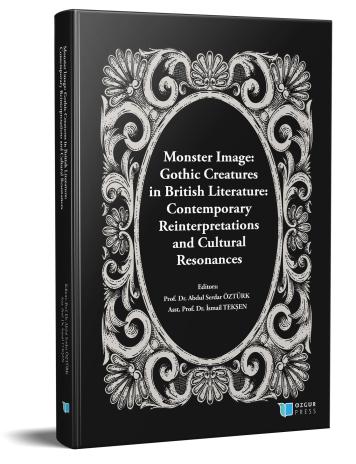
Playing God and the Aesthetics of Exclusion: Unveiling the True Monster in Mary Shelley’s Frankenstein
Şu kitabın bölümü:
Öztürk,
A.
S.
&
Tekşen,
İ.
(eds.)
2025.
Monster Image: Gothic Creatures in British Literature Contemporary Reinterpretations and Cultural Resonances.
Özet
Monster figures have traditionally represented something inhuman or partially human. As a pioneer of the Gothic genre, Frankenstein both transformed this genre and provided a new perspective on the definition of a monster, a perspective that has endured for two hundred years. This chapter examines how Mary Shelley, a prominent female writer of the time, wrote this story in the context of the Enlightenment era, as well as the consequences of humanity’s assuming the role of the God. Furthermore, it explores the topics science has addressed, their reflections from the nineteenth century to the present, and the concept of the successful scientist as represented by Doctor Victor Frankenstein. Also, it reveals whether scientists choose to play the role of the God or science itself, while working on a new discovery, as the character Victor does. On the other hand, the concept of the absence of divinity (atheism) and the aesthetics embraced by the creature are studied in this context, with an emphasis on both social and psychological consequences. In these circumstances, where unbelief and science come into conflict, they shed light on both Mary Shelley's critique of her time and current studies concerning the concept of creation. As a result, the contemporary reflections and ethical debates surrounding these and similar issues have been examined from both the Creature's and Victor's perspectives, as well as from a discussion of who the true monster is.
Anahtar Kelimeler:
Kaynakça Gösterimi
Lisans

Bu çalışma Creative Commons Attribution-NonCommercial 4.0 International License ile lisanslanmıştır.
Yayın Tarihi
DOI
Kategoriler
Telif Hakkı (c) 2025 Abdul Serdar Öztürk- İsmail Tekşen; Ferhat Ordu- Murat Karakaş- Ali Kubat- Selma Parlakay Topbaş- Afranur Yılmaz- Gözde Begüm Mızrak- Ayça Gülünay- Mustafa Canlı- Asım Aydın- Abdullah Boyar- Gökhan Tugay Köksal- Zeliha Kuruducu- Ömer Özdemir- Nihal Topcu- Lokman Şehitoğlu- Tuba Aydan- İsmail Tekşen