
Hybrid Methods of Machine Learning: Taxonomies, Architectures, and Optimization
Şu kitabın bölümü:
Başar,
Ü.
&
Öztürk,
İ.
(eds.)
2026.
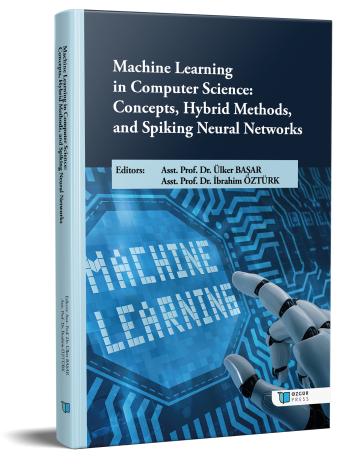
Machine Learning in Computer Science: Concepts, Hybrid Methods, and Spiking Neural Networks.
Özet
Although machine learning models have found a wide range of applications in the literature, being used in pattern discovery, predictive modeling, and decision-making processes in complex data spaces, single algorithms do not possess a universal theoretical and algorithmic superiority across all problem spaces, as mathematically emphasized by the "No Free Lunch" theorem (Wolpert and Macready, 1997). Therefore, hybrid machine learning approaches, which aim to increase generalization power, reduce the risk of getting stuck in local minima, and enhance model robustness by integrating the mathematical, statistical, and computational advantages of different learning paradigms, have been gaining increasing attention in recent years.
This book chapter is structured as a comprehensive literature review addressing the theoretical development of hybrid machine learning methods through the lens of taxonomies, computational architectures, and optimization strategies. The study systematically synthesizes leading and current work in the field, delving deeply into the variance and bias-reduction effects of ensemble learning approaches (bagging, boosting, stacking) and the conceptual integration of symbolic and sub-symbolic methods. Furthermore, sequential, parallel, and hierarchical hybrid architectures are analyzed with respect to information transfer among component models, deep feature fusion mechanisms, and coupling levels. In addition, the integration of metaheuristic algorithms, such as Genetic Algorithms (GA) and Particle Swarm Optimization (PSO), with machine learning is discussed, with approaches proposed in the literature for hyperparameter space exploration, dynamic feature selection, and loss function optimization. This chapter aims to go beyond a purely performance-oriented review and provide a contemporary theoretical reference that highlights how hybrid systems overcome fundamental limitations, including the balance between bias and variance, interpretability and verification, and computational complexity.
Kaynakça Gösterimi
Lisans

Bu çalışma Creative Commons Attribution-NonCommercial 4.0 International License ile lisanslanmıştır.
Yayın Tarihi
DOI
Kategoriler
Telif Hakkı (c) 2026 Ülker Başar- İbrahim Öztürk; Yousef Farhang- Ülker Başar- Gökhan Halimoğlu- İbrahim Öztürk- David M. Halliday- Nigar Tuğbagül Altan Gülgün- Havva Gül Koçer- Birkan Büyükarıkan- Esin Ayşe Zaimoğlu