
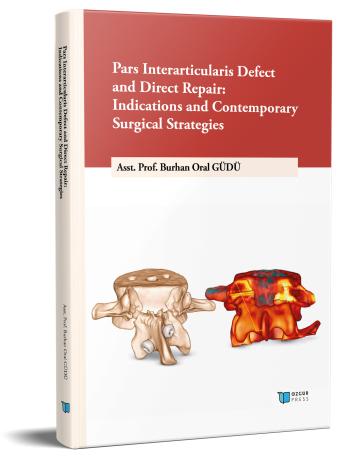
Pars Interarticularis Defect and Direct Repair: Indications, and Contemporary Surgical Strategies
İndir
Özet
Among lumbar spine pathologies, spondylolysis—particularly in young, active, and athletic individuals—is not merely a radiological finding; rather, it represents a dynamic pathological process that directly affects spinal biomechanics and a patient’s quality of life. Often overlooked or sometimes incorrectly regarded as a natural consequence of intense physical activity, this condition may initiate a progressive cascade of biomechanical alterations and degenerative changes if not recognized and treated appropriately.
In recent decades, our understanding of the pathophysiology, biomechanics, and clinical management of pars interarticularis defects has evolved substantially. Advances in imaging techniques, surgical instrumentation, and minimally invasive approaches have transformed the treatment philosophy from purely stabilizing procedures toward strategies that prioritize motion preservation and restoration of physiological spinal mechanics.
This book was conceived to provide a comprehensive and structured overview of spondylolysis and its surgical management, with particular emphasis on pars repair techniques. The chapters cover topics ranging from the anatomical and biomechanical foundations of the pars interarticularis to modern surgical strategies, including intralaminar screw fixation and other motion-preserving repair techniques. By integrating current literature with clinical experience, the aim is to offer both theoretical insight and practical guidance for clinicians dealing with this challenging condition.
One of the central ideas underlying this work is the concept that treatment should aim not only to eliminate pain but also to restore normal spinal biomechanics while preserving the functional integrity of the motion segment whenever possible. In this respect, direct pars repair represents an appealing surgical option for carefully selected patients, particularly young individuals with minimal disc degeneration.
During the preparation of this book, modern artificial intelligence tools were utilized as supportive research assistants for literature organization, language refinement, and structural editing. However, all scientific interpretations, clinical perspectives, and conceptual frameworks presented in this work are the result of the author’s independent academic evaluation and surgical experience.
It is my hope that this book will serve as a practical reference for spine surgeons, neurosurgeons, orthopedic surgeons, and researchers interested in the diagnosis and treatment of lumbar spondylolysis. If the ideas and knowledge presented here contribute—even modestly—to improving the understanding and management of this condition, then the effort invested in preparing this work will have fulfilled its purpose.
Anahtar Kelimeler:
Kaynakça Gösterimi
Lisans

Bu çalışma Creative Commons Attribution-NonCommercial 4.0 International License ile lisanslanmıştır.
Yayın Tarihi
ISBN
DOI
İstatistikler
Kategoriler
Telif Hakkı (c) 2026 Burhan Oral Güdü