
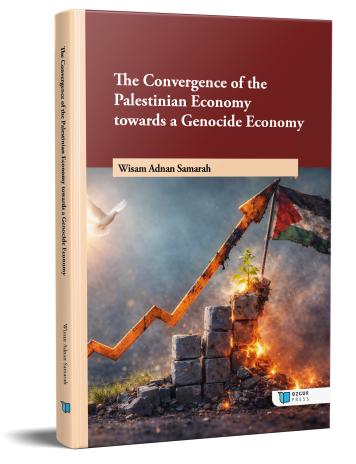
The Convergence of the Palestinian Economy Towards a Genocide Economy
İndir
Özet
This book examines the transformation of the Palestinian economy from a semi-independent or war economy into what is conceptualized as a “genocide economy”—a structure characterized by the systematic destruction of the economic foundations necessary for life, dignity, and recovery. It argues that this transformation is not incidental but the result of a deliberate policy architecture involving territorial fragmentation, prolonged blockade, and the targeted dismantling of productive sectors.
The book pursues four primary objectives: to document and quantify the economic devastation of Gaza using empirical data from national and international sources; to analyze the structural mechanisms of occupation, blockade, and external dependency; to develop the concept of a genocide economy as an analytical framework linking economic collapse to intentional political strategies; and to propose pathways for reconstruction and economic sovereignty grounded in international law.
Methodologically, the book integrates advanced mathematical economics with empirical analysis. A Constant Elasticity of Substitution (CES) production function is employed to model the asymmetric destruction of capital and labor under conditions of conflict. The book quantifies the impact of conflict intensity and blockade duration on macroeconomic performance.
The findings demonstrate that Gaza’s economic collapse deviates from conventional post-conflict recovery patterns, revealing a process of intentional economic non-convergence. The book concludes by outlining policy strategies for reversing this trajectory and restoring a viable, sovereign Palestinian economy.
Kaynakça Gösterimi
Lisans

Bu çalışma Creative Commons Attribution-NonCommercial 4.0 International License ile lisanslanmıştır.
Yayın Tarihi
ISBN
DOI
İstatistikler
Kategoriler
Telif Hakkı (c) 2026 Wisam Adnan Samarah