
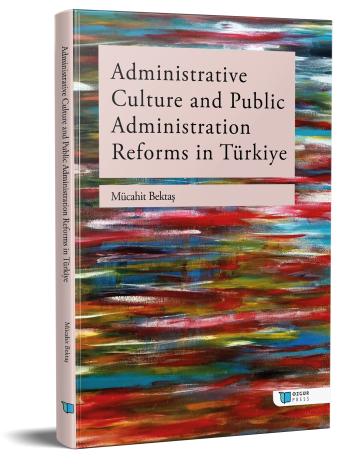
Administrative Culture and Public Administration Reforms in Türkiye
İndir
Özet
Administrative Culture and Public Administration Reforms in Türkiye examines public administration reform not as a sequence of legal amendments or institutional redesigns, but as a long and contested encounter between reform ideas and Türkiye’s administrative culture. The book’s central argument is that reforms in Türkiye cannot be explained only through New Public Management, neoliberal transformation, the European Union accession process, or the preferences of political governments. These factors matter, but they acquire their real meaning only when they meet Türkiye’s centralist state tradition, bureaucratic status elite, paternalist administrative mentality, and historically rooted understanding of authority.
The first part of the book sets out the cultural and historical ground of Turkish public administration. Turkish administrative culture is traced through the Ottoman experience, the Tanzimat period, and the early Republic. In this account, bureaucracy is not treated merely as a technical apparatus serving political authority. It appears as a founding and protective actor of the state. From the Tanzimat onward, the bureaucratic elite gradually became a state elite, and in the Republican period this position was reinforced through a secular, centralist, and status-oriented conception of public interest. This historical inheritance helps explain why reforms in Türkiye have often been designed from above and why bureaucratic resistance has frequently appeared not only as institutional inertia, but also as a defence of the state itself.
The book then reads Turkish administrative culture through Hofstede’s cultural dimensions. Türkiye’s high power distance, high uncertainty avoidance, collectivist tendencies, and paternalist understanding of authority are presented as key features shaping reform outcomes. These characteristics affect not only how public officials behave, but also how citizens imagine the state and how political actors reorganize administration. In such a setting, reforms that aim to increase decentralization, transparency, accountability, participation, flexibility, and citizen orientation do not enter a neutral field. They are translated, narrowed, delayed, or redirected by existing cultural expectations and administrative habits.
The second part focuses on the period between 1980 and 2002. The 24 January Decisions, the 12 September military intervention, the Turgut Özal period, and the European Union process are treated as the main turning points of this era. Özal’s years are presented as the first systematic attempt to move Turkish public administration toward New Public Management through privatization, decentralization, market mechanisms, regulatory institutions, and a more citizen-oriented language of administration. Yet the book also shows that these reforms did not simply copy Anglo-Saxon models. They were adapted to Türkiye’s economic structure, political constraints, and social composition. After Özal, the reform process slowed, while the 1990s became both a period of renewed centralization and an incubation period for the reforms that would follow after 2002.
The third part examines post-2002 reforms. The 2001 economic crisis, the AK Party’s rise to power, the European Union accession process, international organizations, and domestic power struggles created a strong reform environment. Central administration, public financial management, access to information, ethics, ombudsman mechanisms, regulatory agencies, health, development, e-government, the Presidential Government System, and local governments all became major reform fields. Yet the results were uneven. Some reforms strengthened transparency, accountability, service quality, and citizen orientation, while others reinforced centralization and executive dominance.
The book concludes that Turkish public administration reform is neither a simple success story nor a simple failure. It is a recurring struggle between change and inherited administrative culture. Reforms transform institutions, but institutions also transform reforms. For this reason, understanding reform in Türkiye requires looking not only at laws and policy documents, but also at the deeper assumptions about the state, authority, bureaucracy, citizens, and change that continue to shape administrative life.
Anahtar Kelimeler:
Kaynakça Gösterimi
Lisans

Bu çalışma Creative Commons Attribution-NonCommercial 4.0 International License ile lisanslanmıştır.
Yayın Tarihi
ISBN
DOI
İstatistikler
Kategoriler
Telif Hakkı (c) 2026 Mücahit Bektaş