
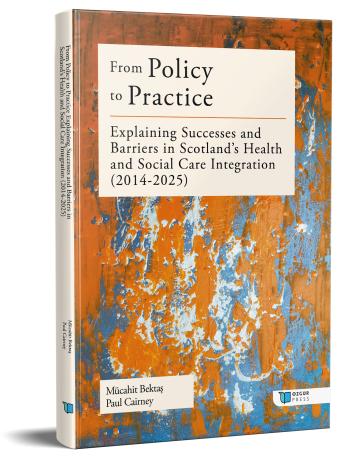
From Policy to Practice Explaining Successes and Barriers in Scotland’s Health and Social Care Integration (2014-2025)
İndir
Özet
Scotland’s 2014 integration settlement sought to shift the system from fragmented delivery to person-centred, outcomes-focused care by delegating key health and social care functions to Integration Authorities (Integration Joint Boards-IJBs) and by requiring local partners to plan and deliver jointly. A decade on, integration is widely supported in principle across participant groups in this study, yet experienced as uneven in practice: the “idea” of integration is often described as self-evident, while its operationalisation is reported as constrained by accountability ambiguity, misaligned incentives, workforce instability, and limited data interoperability.
This report explains why some integration efforts are perceived as successful (often locally and relationally) while barriers persist system-wide. It is based on 44 semi-structured elite interviews (G1-G3) conducted in 2025, supplemented by a structured documentary review of statutory, policy, and evaluative materials covering the 2014-2025 period. Rather than score each area, the report identifies recurring mechanisms and ‘boundary conditions’ that help explain divergent delivery realities.
Three headline findings stand out. First, participants repeatedly differentiate strategic intent from decision capacity: where decision rights are fragmented across Health Boards, Local Authorities, and IJB governance, integration becomes a negotiation rather than an operating model. Second, “integration” is still frequently experienced as a set of organisational interfaces rather than a redesigned service user journey, particularly where financial rules and performance governance reward organisational protection rather than shared outcomes. Third, where integration is seen to work, it is typically enabled by relational infrastructure: Stable leadership, trusted boundary-spanning roles, and practical joint working at locality level; these conditions are vulnerable to turnover, fiscal tightening, and inconsistent data systems.
Recommendations are therefore structured at two levels. At strategic level, the report prioritises clarifying accountability and decision rights; strengthening commissioning and incentive alignment (including transparent reserves and set-aside practices); and investing in workforce capacity and data interoperability as core integration enablers. At operational level, the report proposes implementable actions for the next 0-24 months: Joint planning cycles, shared performance conversations, practical information-sharing protocols, and structured engagement with third sector and service users that goes beyond consultation. This report does not argue for a wholesale replacement of Scotland’s current integration settlement. Its main recommendations are oriented towards improving delivery within the existing institutional architecture, while also identifying a smaller set of more ambitious structural options for longer-term consideration
Finally, the report situates these recommendations within the 2026 implementation landscape, including the Care Reform (Scotland) Act 2025 and the planned national rollout of MyCare.scot (Digital Front Door). These developments create both opportunities and risks: They can provide a clearer national “operating environment” and digital access pathway, but only if they are coupled with local capacity, governance clarity, and inclusion safeguards.
Anahtar Kelimeler:
Kaynakça Gösterimi
Lisans

Bu çalışma Creative Commons Attribution-NonCommercial 4.0 International License ile lisanslanmıştır.
Yayın Tarihi
ISBN
DOI
İstatistikler
Kategoriler
Telif Hakkı (c) 2026 Mücahit Bektaş- Paul Cairney