
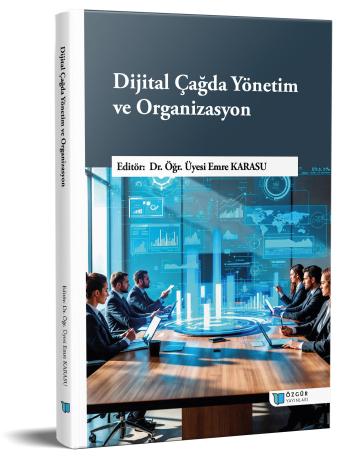
Automation of Management Functions: Functions, Benefits, and Risks of Algorithmic Management
Chapter from the book:
Karasu,
E.
(ed.)
2026.
Management and Organization in the Digital Age.
Synopsis
With the proliferation of digitalisation, big data and artificial intelligence applications, algorithmic management has become an increasingly important managerial mechanism within organisations. Algorithmic management refers to the partial or complete automation of management functions traditionally carried out by human managers, such as task assignment, planning, performance evaluation, remuneration and dismissal, through various software and data-driven algorithms. Algorithms, which initially aimed to solve complex problems by breaking them down into simple steps, now play a significant role in coordinating work processes and controlling the labour process. In the literature, algorithmic management is considered both a management approach that increases organisational efficiency and a contradictory system that poses various risks for employees. At the organisational level, algorithmic systems are said to offer significant benefits, such as enabling faster and more consistent decision-making through big data analysis, real-time task distribution, increased efficiency, accelerated recruitment processes, reduced costs, and support for organisational learning. However, from an employee perspective, algorithmic management may lead to various problems such as reduced job autonomy, techno-stress, intense surveillance, lack of transparency, risk of discrimination, and emotional alienation. In this context, algorithmic management is considered a two-sided transformation that promises efficiency and rationality while also producing complex consequences for employee well-being, perceptions of fairness, and organisational relationships. Therefore, it is crucial that the design of algorithmic systems takes into account not only efficiency goals but also human-centred elements such as employee autonomy, transparency, and accountability.
How to cite this book
License

This work is licensed under a Creative Commons Attribution-NonCommercial 4.0 International License.
Published
DOI
Categories
Copyright (c) 2026 Emre Karasu; Burcu Şefika Doğrul- Aytül Güneşer Demirci- Mehmet Yıldırım- Birol Altun- Barış Kara- Emre Karasu