
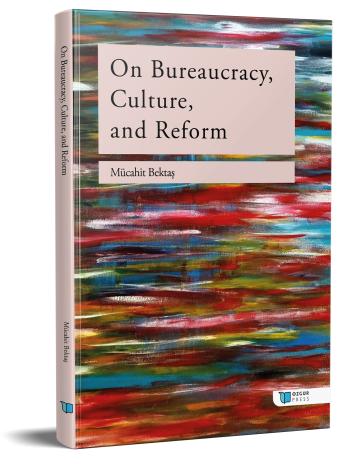
On Bureaucracy, Culture, and Reform
İndir
Özet
On Bureaucracy, Culture, and Reform examines the relationship between three concepts that are often discussed separately in public administration literature: bureaucracy, culture, and reform. The book’s main argument is that bureaucracy should not be understood only as a technical or organizational mechanism. It is also a cultural and political structure shaped by historical experience, institutional habits, administrative traditions, and relations of authority. For this reason, public administration reform cannot be explained merely through legal arrangements, organizational charts, or managerial techniques. Its real character becomes visible when one asks how bureaucratic structures interpret, absorb, resist, or reshape reform initiatives.
The first part of the book discusses the definition, nature, and growing power of bureaucracy. With the rise of the modern state, the expansion of public responsibilities, and the increasing complexity of social needs, bureaucracy became one of the indispensable forms of governance. In its Weberian legal-rational form, bureaucracy rests on hierarchy, specialization, written rules, division of labor, continuity, merit, impersonality, and institutional memory. These features allow the state to implement political decisions, deliver public services regularly, and maintain administrative stability. Yet the book does not present bureaucracy as an entirely positive phenomenon. The same qualities that make it necessary can also produce rigidity, excessive proceduralism, centralization, self-protection, and distance from democratic control.
The second part brings culture into the analysis and shows why administrative life cannot be understood through formal structures alone. Culture shapes how individuals and institutions approach authority, hierarchy, rules, uncertainty, initiative, responsibility, and change. At the level of public administration, this appears as administrative and bureaucratic culture: the routines, values, symbols, expectations, and informal codes through which public institutions conduct their work. These cultural patterns affect how decisions are made, how citizens are approached, and how reform is received. Therefore, reform cannot be reduced to transferring a successful model from one country or institution to another. The same reform instrument may produce different outcomes because it encounters different administrative traditions and bureaucratic reflexes.
The third part connects bureaucratic culture with public administration reform through the relationship between bureaucracy and politics. The traditional view that politics decides and bureaucracy merely implements is treated as insufficient. Bureaucrats influence policy through expertise, technical knowledge, institutional continuity, control over information, and organizational capacity. This does not mean that bureaucracy should replace politics. Rather, it means that the political dimension of bureaucracy must be recognized and kept within legal, democratic, and accountable limits. Within this framework, New Public Management is interpreted not simply as a set of managerial tools, but as a reform paradigm that seeks to reshape bureaucratic culture through efficiency, performance, flexibility, decentralization, quality, citizen orientation, and managerial initiative.
The book concludes that durable reform requires more than technical redesign. Bureaucracy provides the institutional form of modern public administration, culture gives meaning to administrative behaviour, and reform reveals the tensions that emerge when established patterns are asked to change. A sound reform process should therefore neither abolish bureaucracy nor ignore culture. It should preserve the functional capacities of bureaucracy while transforming its rigid, closed, and self-protective tendencies. Genuine public administration reform becomes possible only when structure, culture, and politics are thought together.
Anahtar Kelimeler:
Kaynakça Gösterimi
Lisans

Bu çalışma Creative Commons Attribution-NonCommercial 4.0 International License ile lisanslanmıştır.
Yayın Tarihi
ISBN
DOI
İstatistikler
Kategoriler
Telif Hakkı (c) 2026 Mücahit Bektaş