
Few-Shot Learning: Conceptual Framework, Methodological Developments, and Security Dimensions
Şu kitabın bölümü:
Yılmaz,
A.
(ed.)
2026.
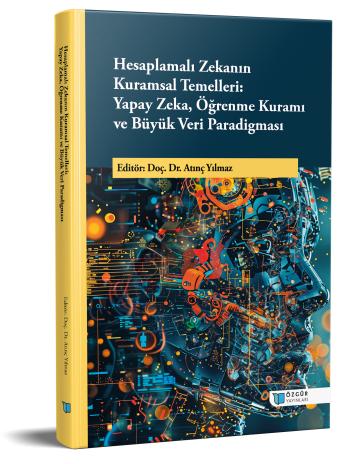
Hesaplamalı Zekanın Kuramsal Temelleri: Yapay Zeka, Öğrenme Kuramı ve Büyük Veri Paradigması.
Özet
The emergence of deep learning has largely been founded on the assumption of access to large-scale labeled datasets. However, in many real-world domains—ranging from medical imaging and the preservation of low-resource language families to space exploration and financial fraud detection—data are not always abundant or readily available. Annotation costs, privacy constraints, and the inherent rarity of certain phenomena constitute structural barriers to the practical deployment of machine learning systems. In this context, efforts to endow machines with the ability to “generalize from a few examples,” a fundamental characteristic of human cognition, have given rise to the field of Few-Shot Learning (FSL).
This review article reconstructs the FSL literature around three principal paradigms: model fine-tuning, data augmentation, and transfer learning. Within the transfer learning framework, meta-learning mechanisms are examined in depth, and metric-based, optimization-based, and model-based approaches are comparatively analyzed. Furthermore, in light of the security threats that have recently emerged in this domain, feature-level adversarial attacks (FAMF) against metric-based models are comprehensively evaluated for the first time within this framework. The attack mechanisms, empirical findings, and defensive strategies are critically discussed. By identifying the structural challenges facing this field and outlining future research directions, this study argues that FSL should be regarded not merely as a technical subfield, but as a strategic turning point for the reliability and robustness of artificial intelligence systems.
Anahtar Kelimeler:
Kaynakça Gösterimi
Lisans

Bu çalışma Creative Commons Attribution-NonCommercial 4.0 International License ile lisanslanmıştır.
Yayın Tarihi
DOI
Kategoriler
Telif Hakkı (c) 2026 Atınç Yılmaz; Sara Naghib Zadeh- Zühre Aydın- Hatice Nur Gök- Cansu Arslan- Uygar Aydın- İnci Zaim Gökbay- Mehmet Dinçer Erbaş- Kenan Peker- Gökhan Önder Ergüven- Tevfik Erdal Baylay- Atınç Yılmaz