
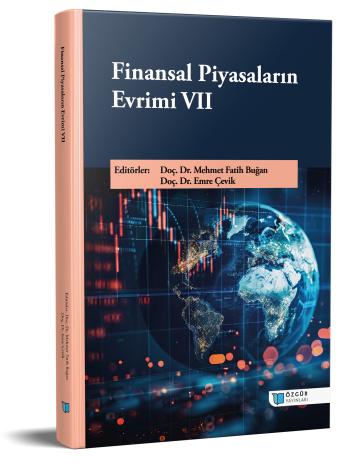
Green Bonds in Climate Finance: Incentives, Performance, and Governance
Chapter from the book:
Buğan,
M.
F.
&
Çevik,
E.
(eds.)
2025.
Evolution of Financial Markets VII.
Synopsis
This study examines the role of green bonds in climate finance within the context of incentive structures, pricing behavior, performance outcomes, and governance frameworks. Following the Paris Agreement, the green bond market has expanded rapidly, serving as an important bridge between environmental objectives and capital markets while simultaneously raising concerns regarding credibility and greenwashing risks. The literature indicates that green bond issuance can, in certain contexts, reduce emission intensity and improve environmental performance; however, the effectiveness of these outcomes appears to depend strongly on governance quality, verification mechanisms, and the regulatory environment. Similarly, financial performance and pricing outcomes are found to be heterogeneous, with the price premium attributed to green bonds varying according to market structure, certification standards, and investor preferences. Empirical evidence further suggests that information asymmetries, incomplete contractual frameworks, and the absence or insufficiency of regulatory approaches to green bonds can increase the risk of greenwashing. Conversely, it has been observed that this divergence remains more limited in situations where strong regulatory and climate governance mechanisms are in place. Overall, the study shows that the effectiveness of green bonds depends less on issuance volume than on the quality of institutional design, and it contributes a descriptive and comparative perspective to the sustainable finance literature.
How to cite this book
License

This work is licensed under a Creative Commons Attribution-NonCommercial 4.0 International License.
Published
DOI
Categories
Copyright (c) 2025 Mehmet Fatih Buğan- Emre Çevik; Muhammed Hadin Öner- Umut Kemeç- Necla Tunay- Yaşam Demir- İlker Sakınç- S. Öznur Sakınç- İbrahim Yaşar Gök