
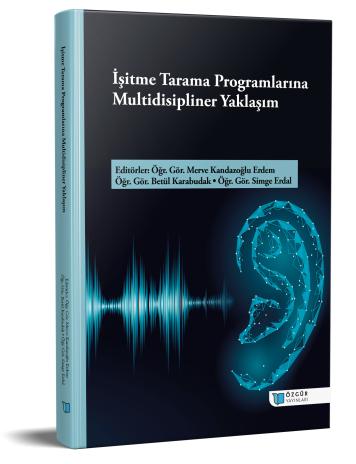
Hearing Screening Programs and Protocols for School-Age Children
Chapter from the book:
Kandazoğlu Erdem,
M.
&
Erdal,
S.
&
Karabudak,
B.
(eds.)
2025.
Multidisciplinary Approach to Hearing Screening Programs.
Synopsis
Hearing loss in school-age children is a significant public health issue that directly affects language and speech development, academic performance, social interaction, and quality of life. Therefore, hearing screening programs play a critical role in the early detection of hearing loss, particularly mild, high-frequency, unilateral, or fluctuating hearing loss, which can be difficult to detect. This section addresses the prevalence and types of school-age hearing loss and its multifaceted effects on children; it comparatively examines the scope, implementation steps, and scientific basis of national and international screening protocols. The place of different assessment methods in screening programs, their strengths, and limitations are evaluated in light of current guidelines. Screening practices, referral processes, and follow-up mechanisms in Türkiye are explained in detail; the role of practitioners, training requirements, and the impact of field conditions are discussed. Overall, the chapter presents the scientific foundations of school-age hearing screening, implementation models, and recommendations for policy development from a holistic perspective.
How to cite this book
License

This work is licensed under a Creative Commons Attribution-NonCommercial 4.0 International License.
Published
DOI
Categories
Copyright (c) 2025 Merve Kandazoğlu Erdem- Simge Erdal- Betül Karabudak; Tuğba Ural- Merve Kandazoğlu Erdem- Simge Erdal- Esra Kuru- Betül Karabudak- Esra Sarlık- Büşra Nehir Şahin