
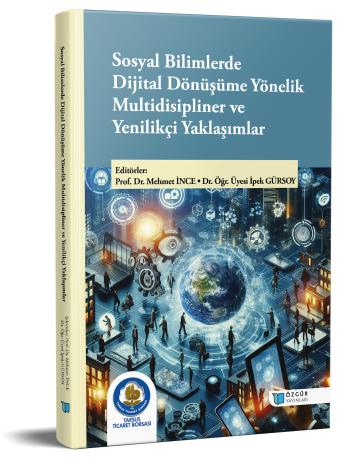
Authenticity in Small-Scale Businesses: The Effect of Commitment on Purchase Intention
Chapter from the book:
İnce,
M.
&
Gürsoy,
İ.
(eds.)
2025.
Multidisciplinary and Innovative Approaches to Digital Transformation in Social Sciences.
Synopsis
Small-scale businesses, particularly those operating in the service sector, are among the key actors that sustain the vitality of local economies, playing an important role in both job creation and the transmission of cultural values. One such group of businesses is small-scale restaurants, which not only provide food and beverage services but also offer customers social interaction, cultural heritage, and authentic experiences. However, academic studies examining the behavioral outcomes of customer experiences in small-scale restaurants remain limited, and within this context, the role of authenticity has not yet been sufficiently clarified. Under conditions of intense competition and during periods of crisis, being perceived as authentic is considered a powerful tool that enables businesses to increase their visibility and expand their customer base without the need for high promotional budgets.
In the literature, authenticity is associated with the perception of a product, service, or experience as sincere, genuine, and non-imitated. In particular, consumers’ increasing demand for authenticity has become a critical factor for customer satisfaction and loyalty in the restaurant industry. Authenticity strengthens customer commitment by fostering emotional bonds between customers and businesses through trust, honesty, and symbolic values. This commitment not only enhances intentions to revisit but also gives rise to positive behavioral tendencies such as word-of-mouth communication and brand advocacy.
This study investigates the effects of perceived authenticity on customer commitment in small-scale restaurants and examines the role of commitment in shaping purchase intention. Within the scope of the research, data collected via questionnaires from 410 restaurant customers with diverse demographic characteristics were analyzed using the SmartPLS (Partial Least Squares) statistical method based on structural equation modeling. The findings indicate that the dimensions of symbolism, reliability, and honesty perceived in customers’ experiences have significant effects on commitment, and that this commitment is one of the strongest determinants of purchase intention.
In conclusion, this study contributes to the academic literature by revealing authenticity-based customer commitment processes in the context of small-scale restaurants, while also offering important implications for practitioners. In particular, the findings provide valuable guidance for small-scale business owners seeking to develop authenticity-driven marketing strategies, supporting the strengthening of customer relationships and the sustainability of competitive advantage.
How to cite this book
License

This work is licensed under a Creative Commons Attribution-NonCommercial 4.0 International License.
Published
DOI
Categories
Copyright (c) 2025 Mehmet İnce- İpek Gürsoy; Ali Şükrü Çetinkaya- Zehra Alakoç Burma- Sibel Çevik- M. Sami Süygün- Pelin Albayrak Fakıoğlu- Senay Oğuztimur- Sinan Çavuşoğlu- Kazım Dağ- Sezen Bozyiğit- Gökçer Aydın- Şükran Dertli- Recep Bozkurt- Eyyüp Akyüz- Özlem İlhan- İlknur Hatice Geçim- Zafer Yıldırım- Turgay Yıldırım- Bensu Narin- Ata Kahveci