
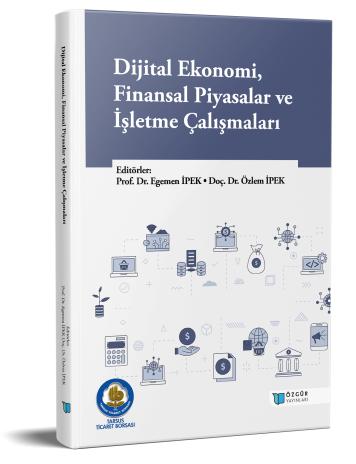
The Causal Relationship Between Economic Policy Uncertainty and Stock Returns: Evidence from Türkiye
Chapter from the book:
İpek,
E.
&
İpek,
Ö.
(eds.)
2025.
Digital Economy, Financial Markets, and Business Studies.
Synopsis
The decision-making process lies at the core of the disciplines of management and economics and is often shaped under conditions of risk and uncertainty. Uncertainty significantly influences individual and institutional behavior through unmeasurable variations inherent in economic decision-making. It can alter the functioning of the economic system through information asymmetry, institutional weaknesses, and external shocks; however, strengthening information quality and institutional mechanisms may mitigate these effects. In recent years, debates on uncertainty have increasingly focused on the unpredictability of government policies. In this context, the Economic Policy Uncertainty (EPU) index—developed to measure uncertainties regarding the direction of fiscal and monetary policies—has emerged as an important indicator that also affects the trajectory of economic activity. Inconsistencies in the policymaking process, fluctuating rhetoric, or unforeseen regulations may lead to a loss of confidence in markets and the postponement of investment decisions. Indeed, the international literature empirically demonstrates that changes in EPU are associated with increased volatility in stock prices, declines in productive investment, and slower economic growth. It is also emphasized that economic policy uncertainty shapes not only investment behavior but also the overall stability of the financial system and investor psychology.
This study examines the relationship between economic policy uncertainty and stock market performance in the case of Türkiye. For this purpose, the causality relationship between the Economic Country-Specific Uncertainty (ECSU) index developed by Kılıç and Ballı (2024) and returns of the BIST 100 index is analyzed using monthly data covering the period from January 2006 to December 2024. Employing Granger causality and frequency-domain causality tests, the study finds evidence of a unidirectional causality running from economic policy uncertainty to stock returns. This result indicates that the equity market exhibits a reactive structure in the face of uncertainty, while uncertainty itself is not a determining factor in the formation of stock market returns.
According to the frequency-domain causality test, although no significant relationship is detected in the short run, changes in uncertainty are found to have a significant impact on stock returns in the medium and long run. This finding suggests that investors exhibit limited reactions to short-term fluctuations, whereas prolonged periods of uncertainty lead to changes in risk perception and pricing behavior. In conclusion, economic policy uncertainty constitutes a critical factor for financial stability, exerting its influence on equity markets in a delayed and cumulative manner. This outcome highlights the necessity for policymakers to establish a trust-based and predictable economic environment.
How to cite this book
License

This work is licensed under a Creative Commons Attribution-NonCommercial 4.0 International License.
Published
DOI
Categories
Copyright (c) 2025 Egemen İpek- Özlem İpek; Gökhan Berk Özbek- Ahmet Koluman- Fatih Kaplan- Yıldız Hoşgör- Nilüfer Yücedağ Erdinç- Emrah Eray Akça- Ayşegül Han- Turgay Yıldırım- Zafer Yıldırım- Saffet Akdağ- Ayşe Akboz Caner - Ayşe Ergin Ünal- Sinan Çavuşoğlu- Özlem Doğan- Mehmet Ali Ekinci- Sevil Özen- Kemal Eyüboğlu- Senem Gazi- Ulaş Buz- Mehtap Delioğlu- Burcu Karaca- Ali Çımat- Sinem Eyüboğlu- Nurten Çakar- Ömer Arı- Erkan Uzun