
Examining the Relationship Between Working Capital and Profitability from a Business Management Perspective: A Study on BIST Insurance Companies
Chapter from the book:
İpek,
E.
&
İpek,
Ö.
(eds.)
2025.
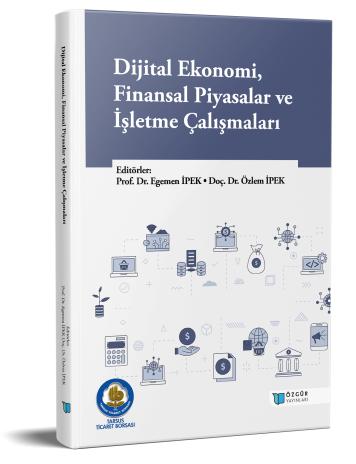
Digital Economy, Financial Markets, and Business Studies.
Synopsis
The management of a firm, the execution of its routine operational activities, and the generation of profit from these activities constitute critical concerns for business owners and managers. In order to operate efficiently and maintain sustainable profitability, managers require adequate funding to support ongoing operations. These funds may be provided either by shareholders or through external financing sources. Insufficient funding can lead to disruptions in business activities, payment difficulties, and increased financing costs, whereas holding excessive funds may result in idle resources and value losses. Both situations ultimately affect the firm’s profitability. These funds, which may also be described as firms’ short-term investments, are defined as working capital.
The aim of this study is to identify the relationship and impact of working capital—an essential component of business operations—on firm profitability. Within the scope of the study, quarterly financial statement data covering the period 2013–2024 for six insurance companies listed continuously on Borsa İstanbul and for which complete data are available were obtained from the Public Disclosure Platform (KAP). A total of 44 quarterly observations per firm were classified and organized in Excel, after which the data were analyzed using Difference GMM and System GMM methods, which are among panel data analysis techniques. The insurance sector was selected for analysis due to the absence of prior empirical studies examining the relationship between working capital and profitability within this specific industry.
The results reveal that working capital management plays a decisive and statistically significant role in determining profitability in insurance companies. Specifically, the coefficient of the accounts receivable collection period (ACP) is found to have a significant and negative effect on profitability, while the accounts payable period (APP) exhibits a significant and positive effect. In addition, the leverage ratio is identified as having a significant negative impact on firm profitability. However, given the structural characteristics of the insurance sector—namely, its relatively limited long-term funding sources and its heavy reliance on current assets and short-term liabilities—the financial leverage ratio may not carry the same explanatory power as it does in other sectors.
On the other hand, other liquidity indicators, such as the cash ratio and asset turnover ratio, are found to have no statistically significant effect on profitability. Overall, the findings highlight the critical importance of effective working capital management for enhancing profitability in insurance companies and contribute to the literature by providing sector-specific empirical evidence.
How to cite this book
License

This work is licensed under a Creative Commons Attribution-NonCommercial 4.0 International License.
Published
DOI
Categories
Copyright (c) 2025 Egemen İpek- Özlem İpek; Gökhan Berk Özbek- Ahmet Koluman- Fatih Kaplan- Yıldız Hoşgör- Nilüfer Yücedağ Erdinç- Emrah Eray Akça- Ayşegül Han- Turgay Yıldırım- Zafer Yıldırım- Saffet Akdağ- Ayşe Akboz Caner - Ayşe Ergin Ünal- Sinan Çavuşoğlu- Özlem Doğan- Mehmet Ali Ekinci- Sevil Özen- Kemal Eyüboğlu- Senem Gazi- Ulaş Buz- Mehtap Delioğlu- Burcu Karaca- Ali Çımat- Sinem Eyüboğlu- Nurten Çakar- Ömer Arı- Erkan Uzun