
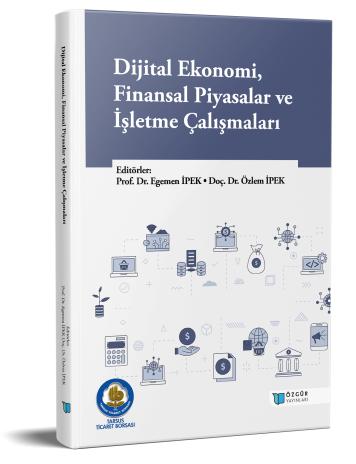
Investigating the Existence of Bubbles in the Increase of Investors’ Risk Appetite During the Post-Pandemic Normalization Period: Evidence from Türkiye
Chapter from the book:
İpek,
E.
&
İpek,
Ö.
(eds.)
2025.
Digital Economy, Financial Markets, and Business Studies.
Synopsis
Risk appetite, as one of the factors influencing investment decisions in financial markets, is a key indicator that shapes investors’ attitudes toward uncertainty, their tendency to invest in risky assets, and consequently the stability of market dynamics. This concept, which affects global financial stability and the direction of capital flows, has gained increasing importance in recent years in the context of heightened economic volatility and policy shifts. In the post-pandemic period, expansionary monetary policies, low interest rates, and increased liquidity conditions have reshaped investors’ risk-taking behavior, creating a significant area of inquiry regarding the sustainability and stability of observed movements in financial asset prices. In this process, particularly in emerging markets, whether price increases exhibit a speculative nature has become a crucial issue for the continuity of financial stability.
This study investigates whether bubbles—namely speculative increases—exist in investors’ risk appetite in the post-pandemic period in Türkiye’s equity markets, using the Risk Appetite Index (REKS). For this purpose, the Supremum Augmented Dickey–Fuller (SADF) and Generalized SADF (GSADF) tests are applied to weekly REKS data for all investors, domestic investors, and foreign investors covering the period from May 16, 2021, to October 6, 2023. These tests are widely recognized in the literature as effective methods for detecting persistent speculative bubbles in financial series.
According to the empirical findings, no statistically significant evidence of bubbles is found in the REKS series for all investors, domestic investors, or foreign investors during the examined period. Accordingly, it is concluded that although investors’ risk appetite increased in a controlled manner in the post-pandemic period, this increase did not lead to the formation of speculative bubbles. In this context, it can be stated that there was no excessive rise in investors’ risk-taking tendencies, price movements remained consistent with market fundamentals, and no speculative surge was observed in Türkiye’s equity market.
The findings present a positive outlook in terms of financial stability and indicate the استمرار of rational investment behavior in the equity market. Moreover, the low speculative risk environment provides a favorable basis for portfolio diversification and suggests that long-term and sustainable investment strategies should be preferred. Additionally, the study demonstrates that monitoring risk appetite dynamics can serve as an important indicator for maintaining financial stability.
How to cite this book
License

This work is licensed under a Creative Commons Attribution-NonCommercial 4.0 International License.
Published
DOI
Categories
Copyright (c) 2025 Egemen İpek- Özlem İpek; Gökhan Berk Özbek- Ahmet Koluman- Fatih Kaplan- Yıldız Hoşgör- Nilüfer Yücedağ Erdinç- Emrah Eray Akça- Ayşegül Han- Turgay Yıldırım- Zafer Yıldırım- Saffet Akdağ- Ayşe Akboz Caner - Ayşe Ergin Ünal- Sinan Çavuşoğlu- Özlem Doğan- Mehmet Ali Ekinci- Sevil Özen- Kemal Eyüboğlu- Senem Gazi- Ulaş Buz- Mehtap Delioğlu- Burcu Karaca- Ali Çımat- Sinem Eyüboğlu- Nurten Çakar- Ömer Arı- Erkan Uzun