
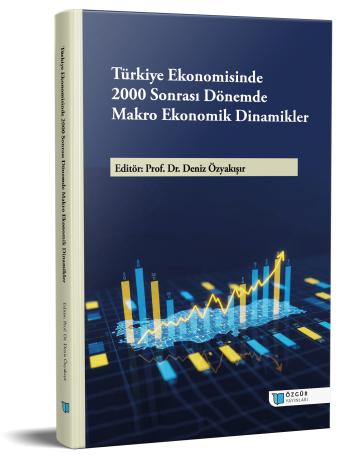
Macroeconomic Dynamics in the Turkish Economy in the Post-2000 Period
Synopsis
In a period when the global economy is changing rapidly, financial markets are shaped by uncertainties, and sustainable development has become more important than ever, addressing issues related to the Turkish economy within a scientific framework is of great value to both academia and policymakers. This book consists of comprehensive studies that evaluate Turkey's economic dynamics from a multidimensional perspective, with solid theoretical foundations supported by empirical analyses.
The chapters in the book offer up-to-date and in-depth analyses in areas such as monetary policy, inflation, unemployment, economic growth, foreign trade balance, financial development, and green economy. Assessments are made across a broad spectrum of complementary topics, ranging from the effects of interest rate decisions on the banking sector to the reflections of globalization processes on social discontent; from the course of growth trends in Turkey after 2000 to unemployment and the role of exchange rate policies on the foreign trade balance. Furthermore, research on green innovation and green growth in the context of sustainable development goals sheds light on one of today's most critical transformation issues.
One of the most important features of this book is that all of its chapters were written by faculty members of the Department of Economics at the Faculty of Economics and Administrative Sciences at Kafkas University. Each of our chapter authors has many years of academic experience in their respective fields of expertise and contributes both scientifically and currently to discussions on the Turkish economy. In this respect, the book highlights the academic production capacity of our faculty and contributes high-quality studies to the economic research literature.
I would like to thank all our esteemed faculty members who contributed to this collective work. By taking time out of their busy academic schedules, have made it possible for this book to become a valuable resource for students, researchers, and decision-makers alike. I would also like to express my gratitude to all my colleagues who supported the preparation of this book and to the publishing house team who contributed throughout the process.
This work in your hands addresses different dimensions of the Turkish economy within a scientific framework, while also serving as a reference source that will inspire new areas of research. I wish our readers an enjoyable and beneficial reading experience.
How to cite this book
License

This work is licensed under a Creative Commons Attribution-NonCommercial 4.0 International License.
Published
ISBN
DOI
Statistics
Categories
Copyright (c) 2025 Deniz Özyakışır