
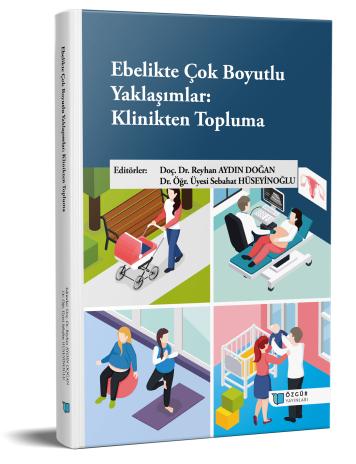
Evidence-Based Approaches in the Early Postpartum Period
Chapter from the book:
Aydın Doğan,
R.
&
Hüseyinoğlu,
S.
(eds.)
2025.
Multidimensional Approaches in Midwifery: From Clinic to Community.
Synopsis
The early postpartum period is one of the most critical stages for both the mother and the newborn. Evidence-based approaches during this period aim to protect maternal health, detect potential complications early, and support mother-infant bonding. For the mother, regular assessment of the amount of vaginal bleeding, monitoring of uterine tone and fundal height, and monitoring of vital signs such as pulse, temperature, and blood pressure at specific intervals are basic practices. Initiating breastfeeding in the first hours supports lactation and contributes to a decrease in postpartum bleeding. Avoiding unnecessary interventions, encouraging mobilization, individualizing pain management, and providing continuous education and counseling to the mother are fundamental elements of evidence-based care. This comprehensive approach facilitates a safe recovery process for the mother and newborn, helping to prevent potential complications.
How to cite this book
License

This work is licensed under a Creative Commons Attribution-NonCommercial 4.0 International License.
Published
DOI
Categories
Copyright (c) 2025 Reyhan Aydın Doğan- Sebahat Hüseyinoğlu; Canan Selvihan İlhan- Reyhan Aydın Doğan- Yasemin Aydın Kartal- Begüm Can- Kübra Şerif Öztürk- Nesrin Arslan- Nurten Özçalkap- Sibel Karakoç- Yeliz Atasoy- Hatice Acar Bektaş- Kübra Özcan- Fatıma Betül Yılmaz- Nargizahon Erkaboeva- Yeter Çuvadar Baş- Rukiye Karabacak- Feyza Nur Altınbaş- Kübra Nur Kılıç- Maral Ovezova- Hilal Kabakçı- Müge Demir- Merve Akıncı- Ayşe Melike Düzyer- Ebru Sağıroğlu- Sebahat Hüseyinoğlu- Yaren Buse Cantimur- Merve Afacan Satıoğlu