
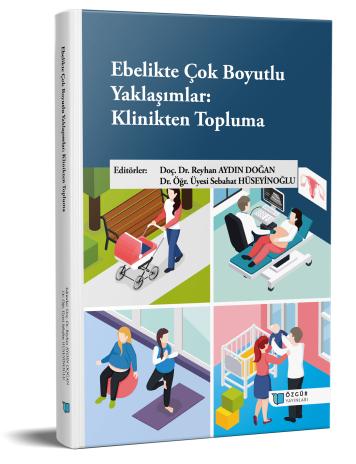
The Role of Midwives in Natural Crises
Chapter from the book:
Aydın Doğan,
R.
&
Hüseyinoğlu,
S.
(eds.)
2025.
Multidimensional Approaches in Midwifery: From Clinic to Community.
Synopsis
Natural crises cause significant losses worldwide and profoundly disrupt social structures. The impacts of such disasters affect not only physical infrastructure but also psychological, socioeconomic, and health domains. Women’s health and reproductive health are among the areas most severely affected during disasters. In this section, the types of natural crises and their effects on women are discussed, and the critical role played by midwives in disasters is emphasized. Midwifery services are of great importance during disasters, particularly in critical areas such as childbirth, newborn care, breastfeeding support, psychosocial support, and the protection of women’s health. During disasters, midwives provide healthcare services throughout women’s childbirth processes, as well as essential support such as newborn care and breastfeeding counseling. In addition, midwives play a crucial role in facilitating access to healthcare services that become limited due to disasters by ensuring health monitoring during the antenatal, intrapartum, and postpartum periods. In disaster-affected areas, midwives not only deliver medical care but also contribute significantly to community recovery by providing psychosocial support. Including the midwifery profession in disaster planning is a critical step not only for the delivery of emergency health services but also for the post-disaster social reconstruction process. This section addresses the definition of natural crises, the importance and roles of midwives in such crises, and the challenges they face. Finally, the importance of strengthening midwifery education, developing policies and regulations to ensure the continuity of midwifery services during disasters, and actively involving midwives in disaster management processes is emphasized.
How to cite this book
License

This work is licensed under a Creative Commons Attribution-NonCommercial 4.0 International License.
Published
DOI
Categories
Copyright (c) 2025 Reyhan Aydın Doğan- Sebahat Hüseyinoğlu; Canan Selvihan İlhan- Reyhan Aydın Doğan- Yasemin Aydın Kartal- Begüm Can- Kübra Şerif Öztürk- Nesrin Arslan- Nurten Özçalkap- Sibel Karakoç- Yeliz Atasoy- Hatice Acar Bektaş- Kübra Özcan- Fatıma Betül Yılmaz- Nargizahon Erkaboeva- Yeter Çuvadar Baş- Rukiye Karabacak- Feyza Nur Altınbaş- Kübra Nur Kılıç- Maral Ovezova- Hilal Kabakçı- Müge Demir- Merve Akıncı- Ayşe Melike Düzyer- Ebru Sağıroğlu- Sebahat Hüseyinoğlu- Yaren Buse Cantimur- Merve Afacan Satıoğlu