
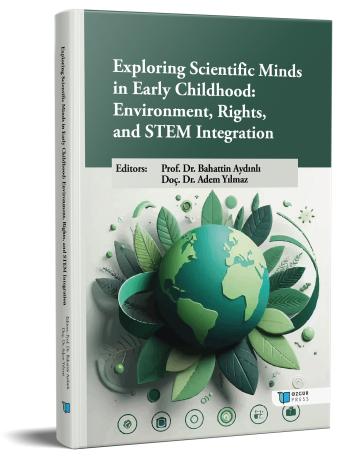
Exploring Scientific Minds in Early Childhood: Environment, Rights, and STEM Integration
Synopsis
Early childhood represents the moment in human development when the mind first attempts to construct systematic meaning out of experience—when curiosity is unfiltered and the desire to explore remains boundless. The questions a child directs toward nature, the sky, living beings, objects, and social life are not merely indications of cognitive maturation; they are also the earliest signals of scientific reasoning. This volume seeks to illuminate the ecological, cultural, and pedagogical contexts in which these signals emerge and take form.
Approaching scientific thinking together with environmental awareness, children’s rights, and STEM integration underscores the fact that early learning can no longer be conceptualized as a single-dimensional process. A child’s sensory, emotional, and cognitive interactions with the environment simultaneously shape sustainability consciousness, democratic participation, and creativity-based technology literacy. This holistic framework enriches children’s learning experiences while expanding the responsibilities and interpretive roles of adults within the educational ecosystem—teachers, families, policy makers, and the wider community.
This book brings together three domains that are often discussed separately in contemporary educational discourse: environmental sensitivity, rights-based pedagogy, and STEM-oriented learning. In doing so, it highlights that the child’s relationship with science carries not only a cognitive dimension but also ecological, ethical, and sociocultural significance. Nature exploration, sky observations, environmental education, democratic classroom participation, family engagement, and STEM activities should therefore be understood as interconnected components of a coherent pedagogical whole.
The world of tomorrow will be shaped by the seemingly small steps taken in today’s early learning environments. Nurturing children’s curiosity, strengthening their environmental consciousness, cultivating their rights awareness, and fostering scientific thinking are no longer optional educational ideals but global imperatives. By compiling contemporary research and perspectives, this work aims to provide educators, researchers, and policy designers with a comprehensive conceptual guide.
Chapters
How to cite this book
License

This work is licensed under a Creative Commons Attribution-NonCommercial 4.0 International License.
Published
ISBN
DOI
Statistics
Categories
Copyright (c) 2025 Adem Yılmaz- Bahattin Aydınlı; Cihan Gülgün- Çağrı Avan- Kamil Doğanay- Kübra Yıldız Şen- Bahattin Aydınlı- Mehmet Kumru- Atila Çağlar- Naim Ünver- Serap Özbaş- Çağatay Ergan- Gülşah Uluay