
Theoretical Groundwork: The Monstrous Bodies and the Gothic Tradition
Chapter from the book:
Öztürk,
A.
S.
&
Tekşen,
İ.
(eds.)
2025.
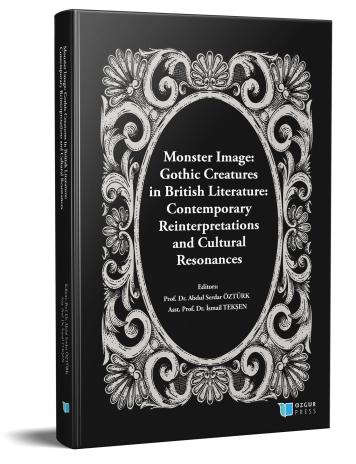
Monster Image: Gothic Creatures in British Literature Contemporary Reinterpretations and Cultural Resonances.
Synopsis
The chapter assembles a theoretical framework used to analyse the monster in the Gothic literary tradition. It combines the basic scholarship to suggest that the monster is a multifaceted cultural representation but not a one-dimensional antagonist. The monster, whose body is a cultural text according to Cohen (1996), derives its power to disrupt order from its status as the abject as defined by Kristeva (1982). It also tracks the symbiotic development of this character as well as of the Gothic tradition, its externalized form as a spectre in haunted castles of the eighteenth century, its internalized form in the form of a psychological twin in the nineteenth century and its modern forms. The crucial aspect of this enquiry is the social and affective role of the monster: to patrol cultural boundaries, project latent desires and bring into being the historically particular anxieties, including scientific hubris, racial trauma. The chapter illustrates the use of Gothic conventions in supplying the narrative grammar to the long-lasting resonance of the monster by a close reading of canonical texts: Frankenstein, Dracula, and Beloved. The overall impact of these necessary views will be seen in the chapter not only making the key areas of the monster theory and Gothic studies clear, but also give a numerical authorised measure of the analyses that follow in this volume, thus, inviting the cameo movement of academic research into the folds of the human condition.
How to cite this book
License

This work is licensed under a Creative Commons Attribution-NonCommercial 4.0 International License.
Published
DOI
Categories
Copyright (c) 2025 Abdul Serdar Öztürk- İsmail Tekşen; Ferhat Ordu- Murat Karakaş- Ali Kubat- Selma Parlakay Topbaş- Afranur Yılmaz- Gözde Begüm Mızrak- Ayça Gülünay- Mustafa Canlı- Asım Aydın- Abdullah Boyar- Gökhan Tugay Köksal- Zeliha Kuruducu- Ömer Özdemir- Nihal Topcu- Lokman Şehitoğlu- Tuba Aydan- İsmail Tekşen