
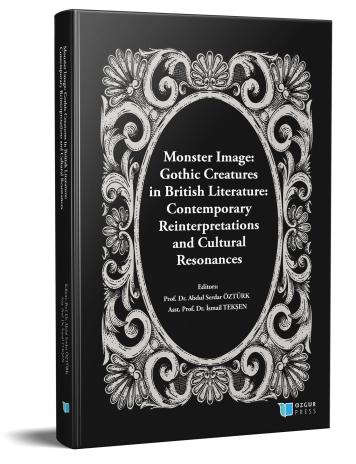
From Victorian Terror to Digital Control: Wells’s The Invisible Man and the Gaze of Surveillance Capitalism
Chapter from the book:
Öztürk,
A.
S.
&
Tekşen,
İ.
(eds.)
2025.
Monster Image: Gothic Creatures in British Literature Contemporary Reinterpretations and Cultural Resonances.
Synopsis
This article argues that H.G. Wells's 1897 novel, The Invisible Man, functions as a radical literary inversion of Jeremy Bentham's Panopticon, offering a profound critique of power, visibility, and social control. The protagonist, Griffin, a brilliant but morally corrupt scientist, achieves absolute invisibility, thereby escaping the social contract and becoming the ultimate "unseen watcher." Unlike the Panopticon's inmate, who is controlled by the possibility of a perpetual gaze, Griffin's unaccountable invisibility grants him freedom that accelerates his descent into megalomania and terror. By detailing the structural reversal embodied by Griffin—the visible majority subjected to the invisible few—this study connects Wells's Victorian-era cautionary tale to modern anxieties surrounding digital surveillance. The essay demonstrates how contemporary phenomena, such as the "chilling effect" of mass monitoring algorithmic gaze of Surveillance Capitalism, realize the terrifying potential of Griffin's "Reign of Terror." Ultimately, The Invisible Man transcends its genre to serve as a timeless reflection on the politics of gaze, warning that the unchecked power of the invisible few will always threaten the liberty of the visible people.
How to cite this book
License

This work is licensed under a Creative Commons Attribution-NonCommercial 4.0 International License.
Published
DOI
Categories
Copyright (c) 2025 Abdul Serdar Öztürk- İsmail Tekşen; Ferhat Ordu- Murat Karakaş- Ali Kubat- Selma Parlakay Topbaş- Afranur Yılmaz- Gözde Begüm Mızrak- Ayça Gülünay- Mustafa Canlı- Asım Aydın- Abdullah Boyar- Gökhan Tugay Köksal- Zeliha Kuruducu- Ömer Özdemir- Nihal Topcu- Lokman Şehitoğlu- Tuba Aydan- İsmail Tekşen