
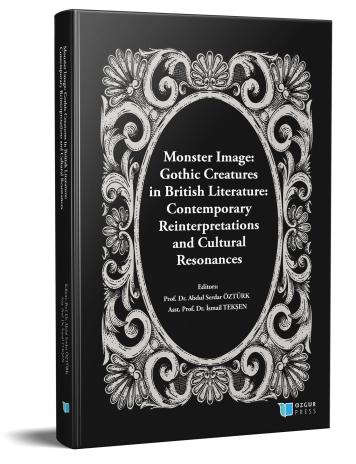
The Green Knight: Proto-Gothic Monster, Suspension, and the Ecology of Horror in Sir Gawain and the Green Knight
Chapter from the book:
Öztürk,
A.
S.
&
Tekşen,
İ.
(eds.)
2025.
Monster Image: Gothic Creatures in British Literature Contemporary Reinterpretations and Cultural Resonances.
Synopsis
This paper discusses the title Green Knight of the late fourteenth century alliterative romance Sir Gawain and the Green Knight as a prototypical Gothic monster, some of whose modes of terribilita are leading indicators for modern horror genre conventions. Even though Gothic literature is often dated back to the publication of Horace Walpole’s 1764 novel The Castle of Otranto, this study reveals how an anonymous medieval writer was responsible for a character with all the features of canonical Gothic: grotesque body, mental apprehension about events, moral complexity and breakdown in civilized society. The Green Knight’s monstrosity works through three dimensions: his visual aberrancy (supernatural greenness, paradoxically noble yet savage aspects, and the refusal to submit to death); his use of that brand of horror mechanics typical for only the most refined beings (temporal choreography, site-specific psychological entrapment outside space-time by way of a one-year contract in uncanny terrain, weaponizing suspense); and finally he functions as a moral judge standing at the head of an elaborate test designed by Morgan le Fay in order reveal how paper-thin is Arthurian perfection. The essay locates the poem in the anxious historical moment of post-Black Death England, contends that the Green Knight’s ecological significance, surveillance-driven judgment, and exposing of the chasm between performed and real identity have never been more salient in light of present fears about environmental cataclysm, loss of privacy, and an inability to keep up false social fronts. Reading the Green Knight as both literary forebear and enduring prototype, this analysis recontextualizes medieval romance in relation to the Gothic novel tradition and argues that the most powerful monsters work not only as destroyers but as revelators of unsettling truths about human vulnerability and civilization precarious.
How to cite this book
License

This work is licensed under a Creative Commons Attribution-NonCommercial 4.0 International License.
Published
DOI
Categories
Copyright (c) 2025 Abdul Serdar Öztürk- İsmail Tekşen; Ferhat Ordu- Murat Karakaş- Ali Kubat- Selma Parlakay Topbaş- Afranur Yılmaz- Gözde Begüm Mızrak- Ayça Gülünay- Mustafa Canlı- Asım Aydın- Abdullah Boyar- Gökhan Tugay Köksal- Zeliha Kuruducu- Ömer Özdemir- Nihal Topcu- Lokman Şehitoğlu- Tuba Aydan- İsmail Tekşen