
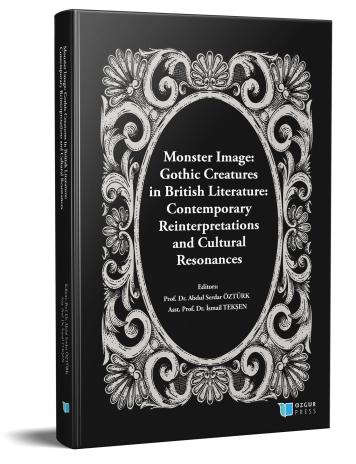
The Vampire in the Void: A Logotherapeutic Reading of Le Fanu’s Carmilla
Chapter from the book:
Öztürk,
A.
S.
&
Tekşen,
İ.
(eds.)
2025.
Monster Image: Gothic Creatures in British Literature Contemporary Reinterpretations and Cultural Resonances.
Synopsis
This chapter provides an extended logotherapeutic analysis of Joseph Sheridan Le Fanu’s (1814–1873) Carmilla (1872), a foundational Gothic novella that has long been read through lenses of sexuality, gender, and the supernatural. By bringing Viktor Emil Frankl’s (1905-1997) Logotherapy into dialogue with the text, this study reconsiders the novella not merely as a work of Gothic horror but as a narrative shaped by nineteenth-century crises of faith, identity, and meaning. Without a doubt, every human being encounters innumerable trials and tribulations throughout life. Pain, death, and guilt are the three most striking of these, which Frankl collected under the heading The Tragic Triad. Such events create an inner void in the individual’s mind and soul, which manifests as depression, aggression, and addiction—what Frankl refers to as The Pathological Triad—if they are not processed healthily through Frankl’s Triad of Pathways: creative, experiential, or attitudinal. This chapter suggests that Carmilla’s vampirism is a psychological expression of this inner void, rather than a supernatural characteristic, in line with the nineteenth-century global crises of faith and identity, particularly with respect to the incapacity to face the trials of the era. Ultimately, this study examines Carmilla (1872) through the lenses of the Tragic and Pathological Triads, demonstrating that what initially appears as an uncontrolled appetite and terror is, in fact, the breakdown of human freedom and the manifestation of spiritual deprivation when the pursuit of meaning fails.
How to cite this book
License

This work is licensed under a Creative Commons Attribution-NonCommercial 4.0 International License.
Published
DOI
Categories
Copyright (c) 2025 Abdul Serdar Öztürk- İsmail Tekşen; Ferhat Ordu- Murat Karakaş- Ali Kubat- Selma Parlakay Topbaş- Afranur Yılmaz- Gözde Begüm Mızrak- Ayça Gülünay- Mustafa Canlı- Asım Aydın- Abdullah Boyar- Gökhan Tugay Köksal- Zeliha Kuruducu- Ömer Özdemir- Nihal Topcu- Lokman Şehitoğlu- Tuba Aydan- İsmail Tekşen