
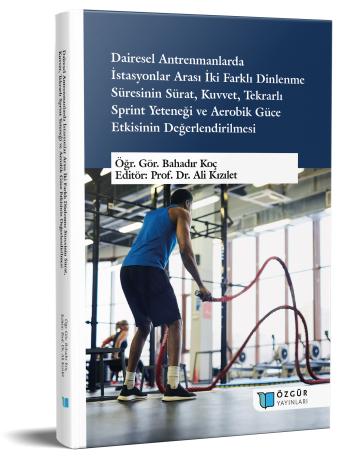
Evaluation of the Effect of Two Different Rest Times Between Stations on Speed, Strength, Repeated Sprint Ability and Aerobic Power in Circuit Training
Synopsis
Purpose: The aim of this study is to investigate the effect of changes in rest periods between stations and sets on speed, strength, repetitive sprint ability and aerobic power.
Materials and Method: Sixteen male athletes in the football team of the School of Physical Education and Sports participated in the study. The athletes were divided into two groups: Inter-station Resting Group (İDG) and Inter-set Resting Group (SDG). The athletes were given a circuit training program for 8 weeks, 2 days a week (Tuesday and Thursday). Before and after the training, physical measurements (height, weight, body fatratio) tests, speed test, repeated sprint test, Yo-Yo Intermittent Recovery Test Level I, long jump test and leg strength test and perceived fatigue level test were applied to the athletes.
Findings: Significant improvement was observed in speed, repetitive sprint and aerobic power characteristics of İnter-sets Resting Group athletes after training. On the other hand, İnter-station Resting Group athletes only showed significant improvement in aerobic power (MaxVO2) after training. When the levels of development of the İnter sets Resting Group and İnter-station Resting Group athletes were compared, it was seen that the Repeated Sprint Ability Fatigue İndex and MaxVO2 values of İnter-set Resting Group showed better improvement than the İnter-station Resting Group.
Conclusions: In circuit training, it was found that inter-set resting was more efficient than inter-station resting to improve repeated sprint ability and aerobic power of athletes in terms of fatigue index.
How to cite this book
License

This work is licensed under a Creative Commons Attribution-NonCommercial 4.0 International License.
Published
ISBN
DOI
Statistics
Categories
Copyright (c) 2025 Bahadır Koç; Ali Kızılet