
Movement-Based Training Strategies for Improving Agility, Speed, and Reaction Skills
Chapter from the book:
Uluç,
E.
A.
&
Zengin,
S.
&
İlhan,
M.
T.
(eds.)
2025.
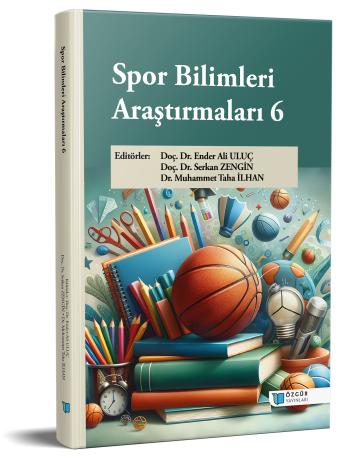
Sports Sciences Research 6.
Synopsis
This book chapter comprehensively addresses movement-based training strategies aimed at improving agility, speed, and reaction ability. Agility determines an athlete's capacity for change of direction and control; speed optimizes linear and short-distance movement performance; and reaction ability affects the capacity to produce quick and accurate responses to environmental stimuli.
The biomechanical and neurophysiological foundations discussed in the chapter demonstrate the decisive role of motor unit activation, muscle-tendon elasticity, and central nervous system adaptations on performance. Movement quality and motor control shape performance in conjunction with the athlete's technical accuracy and efficient energy use.
Training models for speed and agility, and strategies that improve reaction ability, include stimulus-based drills, plyometric applications, and cognitive-motor integration, supporting the multidimensional development of performance. Individualized programming and performance monitoring approaches optimize training load according to the athlete's capacity, reducing the risk of fatigue and injury. In conclusion, movement-based training strategies maximize an athlete's capacity to produce agile, fast, and reactive movements by integrating motor, neurophysiological, and cognitive processes. This holistic approach is critical for sustainably improving athletic performance and establishing safe training practices.
How to cite this book
License

This work is licensed under a Creative Commons Attribution-NonCommercial 4.0 International License.
Published
DOI
Categories
Copyright (c) 2025 Ender Ali Uluç- Serkan Zengin- Muhammet Taha İlhan; Gamze Elif Adiloğulları- Reşat Kartal- Ferhat Aktaş- Deniz Ünver- Ahmet Şahin- Büşra Baykuş- Günseli Duman