
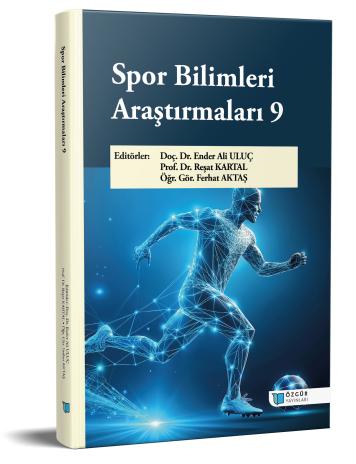
Post-Activation Performance Enhancement (PAPE): Factors Determining Its Effect on Performance
Chapter from the book:
Uluç,
E.
A.
&
Kartal,
R.
&
Aktaş,
F.
(eds.)
2025.
Sports Sciences Research 9.
Synopsis
Coaches and practitioners utilize various strategies, such as warm-up protocols, vibration, and caffeine, to enhance athletes' acute performance. However, one approach that has garnered increasing scientific attention and application in recent years is post-activation performance enhancement (PAPE). PAPE refers to the acute increase in maximal strength, power, and speed performance following a conditioning activity, along with adequate recovery time. Studies have shown that PAPE can improve various performance outcomes such as jump height, sprint performance, strength training volume, 1-repetition maximal strength, and swimming speed.
The PAPE response can be influenced by many factors, including age, gender, strength level, training experience, recovery time, loading intensity, number of sets, contraction type, and exercise selection. In general, individuals with high strength levels and experience in resistance training show a more pronounced PAPE response. Recovery time is crucial as it regulates the fatigue-potentialization balance. Many studies highlight that recovery times of approximately 4-9 minutes can be effective in eliciting an optimal PAPE response, but individualization of this time is crucial. However, dynamic conditioning activities are generally known to be more effective than isometric conditioning activities.
In conclusion, PAPE, when properly planned, is an effective strategy that can acutely improve pre-training and pre-competition performance.
How to cite this book
License

This work is licensed under a Creative Commons Attribution-NonCommercial 4.0 International License.
Published
DOI
Categories
Copyright (c) 2025 Ender Ali Uluç- Reşat Kartal- Ferhat Aktaş; Ahmetcan Tütük- Ali Örenay- Fuat Orkun Tapşın- Hümeyra Ay- Zülbiye Kaçay- Sinem Uluç- Can Özgider- Muhammet Taha İlhan- Alper Kartal- Ferdağ Özaras