
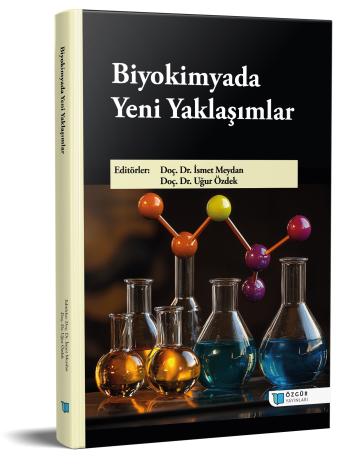
Multidisciplinary Approaches in Biochemistry: Nanotechnology, Artificial Intelligence, and Biosensors
Chapter from the book:
Meydan,
İ.
&
Özdek,
U.
(eds.)
2025.
New Approaches in Biochemistry.
Synopsis
Modern biochemical investigations have progressed to the point where the complex structure of the cell needs to be understood by more diverse disciplines. Traditional biochemical testing methods are important, but they may not adequately reveal the dynamic molecular interactions or small amounts of components in complex biological samples. Therefore, the collaboration between nanotechnology, biosensor systems, and data-information-knowledge-wisdom-supported analytical approaches has emerged as a new concept to significantly improve analytical performance in terms of sensitivity, selectivity, and functional applicability. Nanotechnology has also contributed to contemporary biochemistry by offering products with large surface areas, customizable surface chemistry, and size-dependent optical and electrical properties. This has enabled remarkable advances in biomolecular sensing, signal amplification, and molecular interactions. On the other hand, the development of biosensor technology has revolutionized biochemical analysis by enabling the rapid, instantaneous, and precise detection of biologically important analytes in clinical, environmental, and industrial settings. The combination of nanomaterials and biosensors has enabled the development of more sophisticated analytical systems for generating complex biochemical data. Systematic computational and data-driven evaluation approaches are being progressively integrated, supporting signal processing, pattern recognition, and performance enhancement in analysis to support experimental validation without neglecting fundamental biochemical principles. When used appropriately, these methods have the potential to provide reproducibility and analytical stability. Despite these advances, issues such as reproducibility, long-term stability, standardization, and ethics remain major obstacles to large-scale applications. Overcoming these challenges will require multidisciplinary collaboration, the development of standard practices, and engagement with regulatory authorities. In particular, we highlight recent advances in the multidimensional analysis of biological molecules (and related analytes), focusing on innovations in biosensor technology and their integration with biomolecular processes using nanotechnology-based techniques. This study critically examines trends, challenges, and potential developments in the field, offering a valuable perspective on how the integration of multidisciplinary approaches can influence the future of biochemical research.
How to cite this book
License

This work is licensed under a Creative Commons Attribution-NonCommercial 4.0 International License.
Published
DOI
Categories
Copyright (c) 2025 İsmet Meydan- Uğur Özdek; Nuran Bazancir- Sema Kaptanoğlu- Fatma Calayır- Ali Rıza Kul- Adem Ahlatcı- Ahmet Ufuk Kömüroğlu