
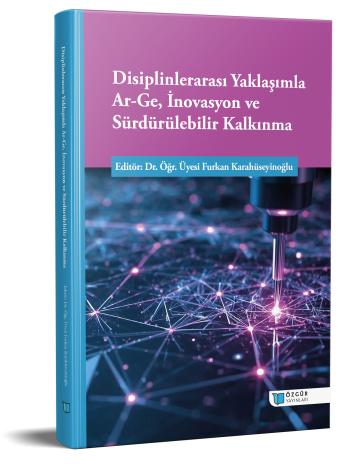
The Invisible Team of Innovation: Smart R&D with AI Agents
Chapter from the book:
Karahüseyinoğlu,
F.
(ed.)
2025.
Research and Development, Innovation, and Sustainable Development through an Interdisciplinary Framework.
Synopsis
Digital transformation has been a significant force shaping innovation and R&D processes. Big data, cloud computing, and Industry 4.0, along with leading artificial intelligence applications, have been the driving forces behind this process. In this context, AI agents and multi-agent systems, the next generation of AI managers, have begun to become the invisible but increasingly important actors of innovation. Agents have started to play a significant role in everything from literature reviews and experimental model design to analysis, system training, reporting, and even market research. As a result of these processes, agents have begun to accelerate innovation and R&D activity cycles.
This research first summarizes classical innovation approaches such as linear, chain-linked, systemic, open, and user innovation; these approaches are reinterpreted from the perspective of agent-based artificial intelligence. Then, the conceptual framework of AI agents is outlined, and the basic components of LLM-based autonomous agents and multi-agent systems are discussed. The study then discusses the roles of agents in the R&D cycle in the contexts of idea generation, literature and patent search, design and simulation, testing and validation, commercialization, and market analysis. Human-agent collaboration models, multi-agent orchestration, and ethical and governance dimensions are examined; and example application scenarios from university-industry collaboration, SMEs, healthcare, energy, and manufacturing sectors are presented. Finally, a future-oriented perspective is developed within the framework of the self-driving laboratories approach and agent-based AI-focused corporate transformation trends. This research argues that artificial intelligence agents are not authorities replacing human intelligence, but rather "intelligent partners" that, when properly designed, accelerate innovation.
How to cite this book
License

This work is licensed under a Creative Commons Attribution-NonCommercial 4.0 International License.
Published
DOI
Categories
Copyright (c) 2025 Furkan Karahüseyinoğlu; Kenan Peker- Bülent Güner- Erkin Başaran- Andaç İmak- Ceren Ünlükal- Elifcan Göçmen Polat- Dilber Coşkun- Ülkü Özbey- Serdal Sabancı- Özlem Ertekin- Zeynep Eroğlu- Arife Macit- Neşe Alıç- Nubar Yasan Güneş- Kübra Ataş- Ceyhun Topcuoğlu- Erhan Kızmaz- Esin Özçiçek- Ragıp Adıgüzel- Mehmet Tevfik Ağdaş- Nida Demirtas- Nida Platin- Gokhan Onder Erguvan- Alper Guven- Furkan Karahüseyinoğlu