
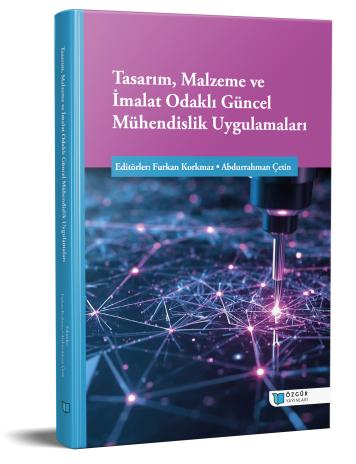
Industry 4.0 and Smart Production Systems in Manufacturing
Chapter from the book:
Korkmaz,
F.
&
Çetin,
A.
(eds.)
2025.
Current Engineering Applications Focused on Design, Materials, and Manufacturing.
Synopsis
Industry 4.0 transforms manufacturing processes from traditional production lines into smart, flexible, and self-organizing systems, providing gains in efficiency, transparency, and sustainability. IoT-based production monitoring systems enable real-time data flow between machines, sensors, and network technologies, offering advantages in predictive maintenance, energy efficiency, and supply chain management. Digital twins provide virtual replicas of physical systems, allowing performance monitoring, scenario analysis, and operational optimization, and supporting proactive approaches in maintenance and lifecycle management. Artificial intelligence techniques, including machine learning, deep learning, and evolutionary algorithms, enhance production flexibility and accuracy through defect prediction, quality control, scheduling, and process improvement. The integration of these technologies facilitates cost reduction, minimizes downtime, and improves operational efficiency. However, data security, system integration, and infrastructure requirements remain key challenges for digital transformation. An effective Industry 4.0 implementation requires not only technological competence but also a transformation in organizational culture and process management. IoT, digital twins, and artificial intelligence emerge as strategic tools enabling advanced automation, optimization, and sustainability in manufacturing.
How to cite this book
License

This work is licensed under a Creative Commons Attribution-NonCommercial 4.0 International License.
Published
DOI
Categories
Copyright (c) 2025 Furkan Korkmaz- Abdurrahman Çetin; Emel Çelik- Abdurrahman Çetin- Sinan Serdar Özkan- Nergizhan Anaç- Oğuz Koçar- Erhan Baysal- Furkan Parmaksız- Zeynep Hale Şimşir- Bilal Kaya- Furkan Korkmaz- Erhan İbrahimoğlu- Fatih Çalışkan- Tuğçe Tezel- Volkan Kovan