
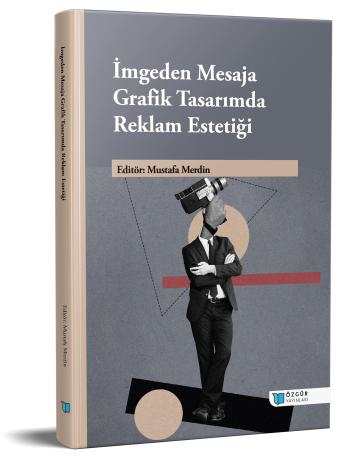
Myth Creation and Illustrative Sign Systems in Modern Advertising
Chapter from the book:
Merdin,
M.
(ed.)
2025.
From Image to Message: Advertising Aesthetics in Graphic Design.
Synopsis
This research examines the structure of myth production in modern advertising and the central role that illustration plays within this process, employing semiotic and cultural theory as its analytical framework. It emphasizes that advertising functions not merely as an economic communication practice but as a signifying system through which cultural meanings are produced, circulated, and ideologically naturalized. Drawing on theoretical perspectives from Barthes, Peirce, Kress & Van Leeuwen, Hall, and Assmann, the chapter discusses myth, representation, iconicity, and cultural memory while explicating the multilayered nature of illustrative signs.
Through its formal and symbolic capacities, illustration enables products to be transformed into objects of desire, narrativized, rendered iconic, and emotionally framed. Case analyses focusing on themes such as national identity, technology, ecology, and youth reveal how illustrative advertising campaigns reproduce and reinforce cultural codes. At the same time, the ideological functions of advertising myths are critically evaluated, demonstrating how visual naturalization mechanisms obscure consumption dynamics, identity constructions, and power relations. The chapter also highlights the potential of counter-myth practices such as culture jamming to disrupt hegemonic narratives.
In conclusion, illustration is positioned not merely as a tool of visualization but as a versatile semiotic domain in which cultural myths are produced, circulated, and at times contested. Processes such as digitalization, artificial intelligence, and cultural hybridization indicate that illustrative myths will become increasingly diversified in the future.
How to cite this book
License

This work is licensed under a Creative Commons Attribution-NonCommercial 4.0 International License.
Published
DOI
Categories
Copyright (c) 2025 Mustafa Merdin; Burçe Akcan- Yasemin Tanrıverdi- Burhan Şohoğlu- Ozan Küçükusta- M. Furkan Terzi- Mustafa Merdin