
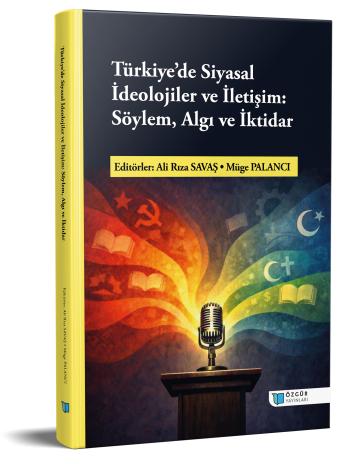
The Discursive and Affective Construction of Nationalist Ideology:A Content Analysis of Devlet Bahçeli’s Official Speeches in 2023
Chapter from the book:
Savaş,
A.
R.
&
Palancı,
M.
(eds.)
2025.
Political Ideologies and Communication in Turkey: Discourse, Perception, and Power.
Synopsis
This study examines the discursive and affective construction of nationalist ideology through an analysis of Devlet Bahçeli’s official speeches delivered in 2023. Rather than approaching nationalism as a purely normative or ideological claim, the study conceptualizes it as an empirically observable and systematically reproducible discursive practice articulated through leader rhetoric. A corpus consisting of Bahçeli’s publicly available speeches was compiled and analyzed using a multi-layered research design that integrates frequency analysis, thematic analysis, and sentiment analysis.
The findings reveal that nationalist discourse is structured around a highly concentrated nation-state core, with concepts such as Turkey, nation, state, and republic occupying a central position in the discursive landscape. Thematic analysis identifies five dominant themes: nation-state and collective identity, state and political authority, ideological movement and alliance, othering and threat discourse, and national–religious legitimation. Together, these themes demonstrate the internal coherence and stability of nationalist ideology as articulated through leader discourse.
Sentiment analysis and the theme × emotion matrix further show that nationalist discourse is affectively organized primarily around pride and anger, rather than fear. Collective identity and state-related themes are strongly associated with pride while othering and threat narratives are structured through anger and negative affect. This affective configuration suggests that nationalist discourse functions less as a fear-driven crisis narrative and more as a mobilizing ideology grounded in collective pride and antagonism.
By combining discursive and affective perspectives within a transparent and replicable methodological framework, the study contributes to the literature on nationalism, political discourse, and political emotions, offering empirical insights from the Turkish political context.
How to cite this book
License

This work is licensed under a Creative Commons Attribution-NonCommercial 4.0 International License.
Published
DOI
Categories
Copyright (c) 2025 Ali Rıza Savaş- Müge Palancı; Ali Rıza Savaş- Cengiz Gürbüz- Ertuğrul Buğra Orhan- Şaban Öztürk- Ahmet Hikmet Zabun- Ayşegül Melis Yurdakul- Müge Palancı