
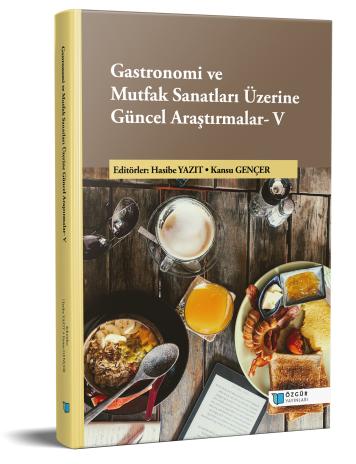
Neurogastronomy: The Neurobiological Foundations of Taste and Smell Perception
Chapter from the book:
Yazıt,
H.
&
Gençer,
K.
(eds.)
2025.
Current Research on Gastronomy and Culinary Arts- V.
Synopsis
The goal of the developing multidisciplinary discipline of neurogastronomy, which unites neuroscience, sensory science, and gastronomy, is to clarify how the brain creates the multimodal perception of flavor. The neurological underpinnings of taste and smell perception are examined in this book chapter, with a focus on how they are integrated into a single flavor The olfactory bulb, piriform cortex, amygdala, and hippocampus networks all participate in the parallel but interacting process of olfactory perception, which is started by odorant binding in the olfactory epithelium. The chapter emphasizes that the main neurological substrate where gustatory, olfactory, somatosensory, and even visual information combine to create the conscious sense of flavor is convergent processing in the orbitofrontal cortex. percept. Taste transduction begins with specific receptors on the tongue that encode basic taste properties, which are communicated through cranial nerves to the nucleus of the solitary tract and then to higher cortical regions, including the insular and orbitofrontal cortices. Recent developments in brain imaging, neurocognitive modeling, and chemical sensing demonstrate that flavor perception is impacted not just by stimulus qualities but also by memory, expectation, and emotional context. This chapter offers a thorough framework for comprehending how the brain interprets chemical, mechanical, and visual cues during eating by combining recent findings from neurobiology, cognitive neuroscience, and food science. In general, this section provides a basis for future research into the complex interaction between sensory systems and the brain in neurogastronomy.
How to cite this book
License

This work is licensed under a Creative Commons Attribution-NonCommercial 4.0 International License.
Published
DOI
Categories
Copyright (c) 2025 Hasibe Yazıt- Kansu Gençer; Atilla Akbaba- Alpay Tırıl- Müesser Korkmaz- Tarık Komşular- Aslı Muslu Can- Ayşen Develioğlu Arslan- Gülsüm Yurtseven- Hasan Samet Tandoğan- Mehmet Sedat İpar- Şüheda Hilal Güven- Gülsün Duran- Mert Can Tekeler- Begüm Dilara Emiroğlu- Betül Yeşiltepe Erkayıran- Mesut Mehmet Demirel- Gülnisa Turan- Hasibe Yazıt- Volkan Aslan