
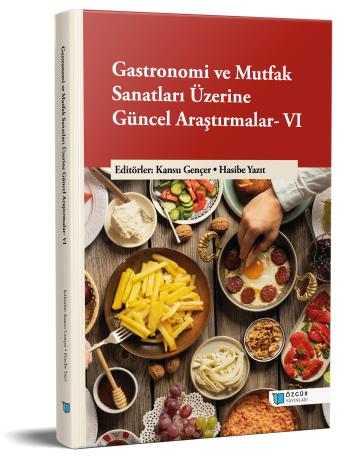
Next Generation Gastronomy, Where is Digitalization in Gastronomy Heading?
Chapter from the book:
Gençer,
K.
&
Yazıt,
H.
(eds.)
2025.
Current Research on Gastronomy and Culinary Arts-VI.
Synopsis
The use of technology driven by Industry 4.0 has created dramatic changes for both tourism and gastronomy. The Tourism 4.0 model uses new technologies such as: Big Data, Internet of Things (IoT), Artificial Intelligence (AI) and Virtual Reality (VR) to create personalized experiences for tourists while improving operational efficiencies and enhancing the competitive advantages of businesses. The technological advancements of the Tourism 4.0 model have been extended to all aspects of the gastronomy value chain through the Gastronomy 4.0 model. From food production through the supply chain, to the operation of the kitchen and the preparation of dishes for presentation and marketing, smart kitchen systems, robotic applications, digital menus, mobile apps, chatbots, social media, 3D printing, IoT-based equipment, thematic and telematic restaurants, and AI supported robotic chef's are being used as an integral part of modern gastronomic practices. Gastronomy 4.0 creates new opportunities for reducing costs, accelerating business processes, reducing food waste, increasing food safety, supporting sustainable production and enabling consumers to experience culinary products in a multisensory and experiential way. Businesses that adapt to the digital transformation can be more responsive to changing consumer needs and preferences. The kitchens of the future will be characterized by a more visible presence of AI and robots and by data driven decision-making processes.
How to cite this book
License

This work is licensed under a Creative Commons Attribution-NonCommercial 4.0 International License.
Published
DOI
Categories
Copyright (c) 2025 Kansu Gençer- Hasibe Yazıt; Serap Nazır- Uğur Can Aykanat- Merve Karakurluk- Yasemin Ersoy- Mehmet Polat- Okan Oğuz- Mehmet Özdamar- İbrahim Canbey- Ömür Alyakut- Simon Abou Fayad- Davut Uysal- Viana Hassan- Marie-Charbel Raymond Badran- Gülsüm Yurtseven- İrem Çafa- Yılmaz Seçim- Ayşe Büşra Madenci