
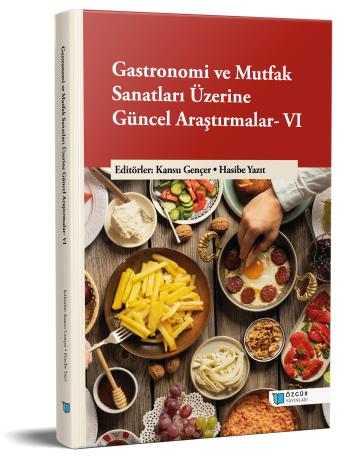
Sensory Analysis Methods in Gastronomy and Consumer Experience Research
Chapter from the book:
Gençer,
K.
&
Yazıt,
H.
(eds.)
2025.
Current Research on Gastronomy and Culinary Arts-VI.
Synopsis
Gastronomy science emerges as an interdisciplinary field that examines the historical, cultural, scientific, and artistic dimensions of food and beverages. Within this comprehensive scientific discipline, sensory analysis methods and consumer experience research have gained increasing importance. Sensory analysis can be defined as a scientific approach that enables the systematic evaluation of the sensory properties of foods, and this approach has become an important tool strengthening the scientific foundation of gastronomy. Understanding how the taste, smell, appearance, texture, and auditory properties of foods are perceived and evaluated by human senses is critically important for both gastronomic creativity and consumer satisfaction.
While sensory analysis forms the basis of the scientific approach in gastronomy, consumer experience emerges as one of the most important factors determining the market success of gastronomic products and services. Consumer experience is a holistic concept that is not limited to just the taste of food, but also includes many factors such as the dining environment, service style, presentation, social interaction, and cultural context. Therefore, sensory analysis and consumer experience research in gastronomy constitute two fundamental areas that complement and support each other.
Sensory analysis and consumer experience research represent two fundamental approaches that complement and support each other in the field of gastronomy. While sensory analysis focuses on determining the objective sensory properties of foods, consumer experience research seeks to understand how these properties are perceived and evaluated by consumers. The integration of these two approaches ensures that gastronomic products and services meet both technical excellence and consumer expectations.
The importance of sensory analysis and consumer experience research in gastronomy has been increasing in recent years. Among the main reasons for this increase are rising consumer expectations, intensifying competition in the gastronomy sector, the need to develop innovative products and services, and efforts to strengthen the scientific foundations of gastronomy. Additionally, the emergence of new research areas such as neurogastronomy, food psychology, and experiential marketing has also increased interest in sensory analysis and consumer experience research.
Today, the gastronomy sector is undergoing a rapid transformation due to factors such as global competition, changing consumer expectations, and technological developments. In this transformation process, sensory analysis methods and consumer experience research play critical roles in innovative product development, quality control, menu design, and determining marketing strategies. Particularly, the emergence of new approaches such as molecular gastronomy, fusion cuisine, and sustainable gastronomy has further increased the importance of research in the fields of sensory analysis and consumer experience.
How to cite this book
License

This work is licensed under a Creative Commons Attribution-NonCommercial 4.0 International License.
Published
DOI
Categories
Copyright (c) 2025 Kansu Gençer- Hasibe Yazıt; Serap Nazır- Uğur Can Aykanat- Merve Karakurluk- Yasemin Ersoy- Mehmet Polat- Okan Oğuz- Mehmet Özdamar- İbrahim Canbey- Ömür Alyakut- Simon Abou Fayad- Davut Uysal- Viana Hassan- Marie-Charbel Raymond Badran- Gülsüm Yurtseven- İrem Çafa- Yılmaz Seçim- Ayşe Büşra Madenci