
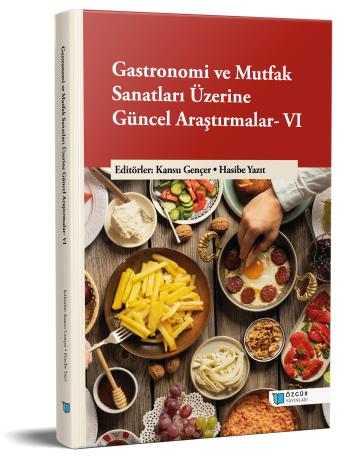
Equipment Hygiene in the Context of Food Safety: Cutting Boards and Knives
Chapter from the book:
Gençer,
K.
&
Yazıt,
H.
(eds.)
2025.
Current Research on Gastronomy and Culinary Arts-VI.
Synopsis
This study conceptually examines the importance of cutting boards and knives in ensuring food safety from a hygiene perspective. Food safety is directly associated with the prevention of foodborne diseases and the protection of public health, and the equipment used in food preparation processes constitutes a critical component of this process.
Cutting boards and knives that come into direct contact with food pose significant risks of cross-contamination when they are not used properly or when hygienic conditions are inadequate. The materials from which these tools are manufactured, their surface characteristics, and usage practices substantially influence the adhesion of microorganisms to surfaces and their transfer between foods. In particular, the structural properties of wooden and plastic cutting boards create favorable conditions for microbial attachment and biofilm formation. Biofilm formation enables pathogens to survive for longer periods on equipment surfaces, thereby increasing food safety risks. These risks become more pronounced under conditions of insufficient cleaning and disinfection, making preventive practices aimed at reducing cross-contamination increasingly necessary. In this context, separating equipment according to food type, using color-coded cutting boards, and maintaining regular and systematic hygiene practices are regarded as effective measures for minimizing cross-contamination.
In conclusion, cutting board and knife hygiene is considered a multidimensional food safety issue that requires a holistic evaluation of equipment selection, usage practices, and systematic hygiene applications.
How to cite this book
License

This work is licensed under a Creative Commons Attribution-NonCommercial 4.0 International License.
Published
DOI
Categories
Copyright (c) 2025 Kansu Gençer- Hasibe Yazıt; Serap Nazır- Uğur Can Aykanat- Merve Karakurluk- Yasemin Ersoy- Mehmet Polat- Okan Oğuz- Mehmet Özdamar- İbrahim Canbey- Ömür Alyakut- Simon Abou Fayad- Davut Uysal- Viana Hassan- Marie-Charbel Raymond Badran- Gülsüm Yurtseven- İrem Çafa- Yılmaz Seçim- Ayşe Büşra Madenci