
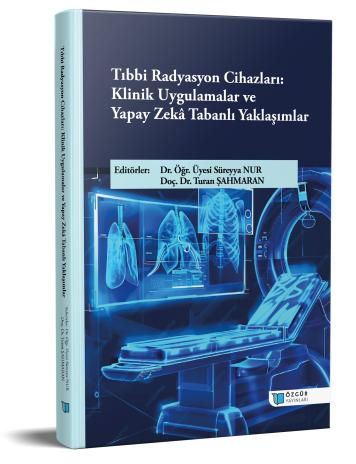
Artificial Intelligence in Radiotherapy Treatment Planning and Contouring
Chapter from the book:
Nur,
S.
&
Şahmaran,
T.
(eds.)
2025.
Medical Radiation Devices: Clinical Applications and AI-Based Approaches.
Synopsis
This section attempts to address the current state, clinical potential, and limitations of artificial intelligence (AI), and especially deep learning (DL),-based automated contouring approaches in the radiotherapy treatment planning process. The multidisciplinary nature of radiation oncology and the need for high accuracy make accurate and consistent contouring of target volumes and organs at risk (OARs) crucial. Traditional manual contouring processes are quite time-consuming, variable depending on the observer, and significantly increase the clinical workload. Therefore, deep learning-based auto-segmentation methods contribute to improving clinical workflows by providing significant advantages in terms of accuracy and efficiency. However, the performance of AI-based systems can vary due to possible differences in imaging protocols, patient-specific characteristics, institution-specific clinical practices, and inconsistencies between contouring guidelines. In addition, the limited correlation of commonly used geometric evaluation metrics with clinical outcomes necessitates careful interpretation of AI outputs. Therefore, adapting AI-based auto-segmentation systems to clinical practice requires a phased approach with comprehensive validation, regular quality control (QA) processes, and expert guidance.
How to cite this book
License

This work is licensed under a Creative Commons Attribution-NonCommercial 4.0 International License.
Published
DOI
Categories
Copyright (c) 2025 Süreyya Nur- Turan Şahmaran; Süreyya Nur- Feryal Çakır- Turan Şahmaran- Esil Kara- Hikmettin Demir- Telat Aksu- Mehmet Hakan Doğan