
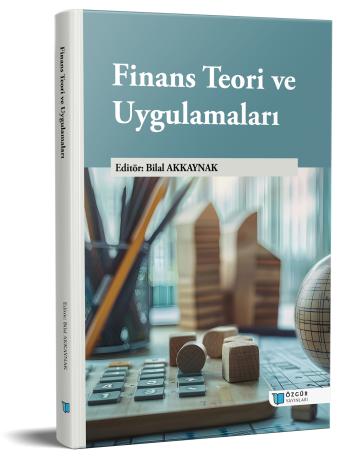
The Impact of Financial Soundness Indicators on Firm Value: Evidence from BIST Industrial Firms
Chapter from the book:
Akkaynak,
B.
(ed.)
2025.
Finance Theory and Practices.
Synopsis
This study examines the effects of financial soundness indicators on the market values of firms listed on Borsa Istanbul using quarterly data from 2019–2024. The analysis is based on a large panel dataset consisting of 6,821 observations from 399 firms. The main purpose of the study is to investigate how the lagged Piotroski F-Score and Altman Z-Score influence firm market values and to reveal investors’ decision‑making behavior based on financial information. In the model, market value is used as the dependent variable, while lagged F-Score, lagged Z-Score, firm size, and leverage ratio serve as independent variables. Given the presence of cross-sectional dependence, autocorrelation, and heteroskedasticity in the panel structure, a static panel model was estimated using Driscoll–Kraay robust standard errors. The findings indicate that both the lagged F-Score and the lagged Z-Score have positive and significant effects on market value. Firms that are financially strong and distant from bankruptcy risk were found to have higher market values. These results show that, during the period under review, investors in BIST Industrial companies prioritized financial soundness rather than speculation. The study’s original contribution lies in the simultaneous examination of two financial soundness indicators and the analysis of investor behavior within this framework.
How to cite this book
License

This work is licensed under a Creative Commons Attribution-NonCommercial 4.0 International License.
Published
DOI
Categories
Copyright (c) 2025 Bilal Akkaynak; Kübra Saka Ilgın- Ahmet Zelka- İsmail Fatih Ceyhan- Berk Yıldız- Ferhat Demirci- Aziz Kaldırım- Bilal Akkaynak- Gülhan Deniz- Muhsin Uslu- Murat Yıldırım- Hacer Şeyma Dilaver- Salim Sercan Sarı- Hilal Ok Ergün- Hümeyra Yıldız- Muhammed Yılmaz- İbrahim Yaşar Gök- İnci Merve Altan- Adem Ruhan Sönmez- Mehmet Ozan Akman- Hasan Aydın Okuyan- Devran Deniz- Elif Sinem Köse- Muhammed Hanifi Van- Yasin Cihan