
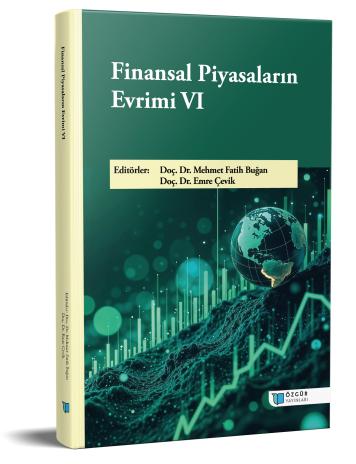
Empirical Analysis of the Relationship Between BIST100 Index and VIX Index
Chapter from the book:
Buğan,
M.
F.
&
Çevik,
E.
(eds.)
2025.
Evolution of Financial Markets VI.
Synopsis
One of the important variables used to forecast the future movements of securities in financial markets is the Volatility Index (VIX), also known as the Fear Index. In addition to being a key indicator examined when making investment decisions in international markets, analyzing the interaction between the VIX index and the BIST100 index is of great importance for investors. This study investigates the relationship between the BIST100 Index and the VIX index, which is widely accepted as a global risk indicator. The analysis is conducted using daily data consisting of 1,257 observations. First, the stationarity of the series is examined using the Augmented Dickey-Fuller (ADF) unit root test, and the results indicate that the BIST100 index is stationary at first difference, while the VIX index is stationary at level. To explore the short- and long-run relationships between the variables, the ARDL model is employed. The findings reveal that increases in the VIX index have a negative and statistically significant effect on the BIST100 index in the short run. However, the long-run coefficients are not statistically significant. The bounds test results suggest that a long-run cointegration relationship between the variables may exist, albeit weakly, at the critical boundary values. Overall, the results indicate that changes in global risk perception play an important role in the Turkish stock market, particularly in the short term.
How to cite this book
License

This work is licensed under a Creative Commons Attribution-NonCommercial 4.0 International License.
Published
DOI
Categories
Copyright (c) 2025 Mehmet Fatih Buğan- Emre Çevik; Lokman Tütüncü- Ahmet Yakup Erkılıç- Rana Torun- İlknur Can- Ayşegül Ertuğrul- Ethem Kılıç- Mert Aktaş- Gizay Daver