
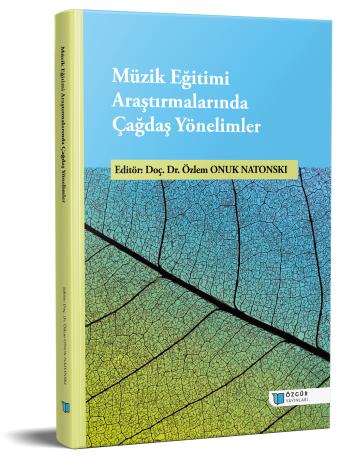
Articulating Collective Memory:Âşık Veysel's Songs and Poets as Intangible Cultural Heritage
Chapter from the book:
Onuk Natonski,
Ö.
(ed.)
2025.
Contemporary Trends in Music Education Research.
Synopsis
This study aims to analyze the poetry and music of Âşık Veysel through the lens of social indicators and intangible cultural heritage, revealing that these works serve a social function beyond their aesthetic value. The central thesis of the study is that Veysel’s oeuvre, far from being merely the expression of an individual artist, embodies multi-layered social indicators that represent the collective memory, value system, and cultural codes of the Anatolian people. The research is grounded in a qualitative textual analysis and shaped by theoretical frameworks drawn from thinkers such as Clifford Geertz, Stuart Hall, Roland Barthes, and Thomas Turino. From this theoretical perspective, iconic lines such as “I am on a long and narrow road” are interpreted as expressions of existential quest. At the same time, “My true beloved is the black earth” is seen as a cultural representation and reproduction of the human–soil relationship. The study demonstrates that Veysel’s legacy operates on three levels: (1) poetry and music function as a social institution by fostering shared affect; (2) themes such as earth, journey, and friendship encode the core values of Anatolian culture; and (3) this legacy continues dynamically through its transition from traditional oral culture to digital circulation. While contributing to the field of cultural sociology through qualitative methodology, the study also positions poetry and music as valuable sources of data for understanding social structures. By highlighting how Veysel’s emphasis on “black earth” may resonate with ecological awareness and how his theme of “friendship” may gain renewed relevance amid contemporary social polarization, the study underscores the enduring value of his legacy as an ethical and cultural resource for addressing current societal challenges.
How to cite this book
License

This work is licensed under a Creative Commons Attribution-NonCommercial 4.0 International License.
Published
DOI
Categories
Copyright (c) 2025 Özlem Onuk Natonski; Yunus Yapalı- Duygu Jafarova- Abdullah Kaya- Özlem Onuk Natonski