
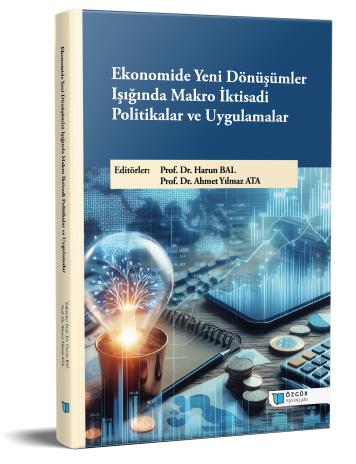
The Relationship Between Global Economic Policy Uncertainty and Economic Stability: Empirical Evidence for Türkiye
Chapter from the book:
Bal,
H.
&
Ata,
A.
Y.
(eds.)
2025.
Macroeconomic Policies and Practices in Light of New Transformations in the Economy.
Synopsis
Global economic developments bring along significant uncertainty factors that directly affect the macroeconomic stability of countries. In this context, the Economic Policy Uncertainty Index (GEPU) has been widely used in recent years to analyze the causes of economic fluctuations. This study analyses the bidirectional causality relationship between the Global Economic Policy Uncertainty (GEPU) index and economic stability in Turkey from 1997 to 2023. Using time series methods, the Toda-Yamamoto causality test results reveal a bidirectional causality between GEPU and GDP. Additionally, unidirectional causality runs from GEPU to inflation and from GEPU to the exchange rate. Variance decomposition findings show that changes in GEPU are primarily explained by interest rates, followed by GDP, inflation, and exchange rates. This highlights that economic uncertainty is mainly influenced by interest rates and, therefore, by monetary policy. The results suggest that ensuring predictable and stable monetary policies is crucial for reducing the negative effects of global economic policy uncertainty on the domestic economy.
How to cite this book
License

This work is licensed under a Creative Commons Attribution-NonCommercial 4.0 International License.
Published
DOI
Categories
Copyright (c) 2025 Harun Bal- Ahmet Yılmaz Ata; Doğan Barak- Halim Tatlı- Fatih Akın- Ayşe Eryer- Rüya Ataklı Yavuz- Refika Görkem Yılmaztürk- Selen Savaşkan- İlknur Aşkın- Harun Bal- Koray Yıldırım- Esma Erdoğan- Süleyman Gürbüz- Nur Aydın- Ayşe Arı- Mehmet Ozan Akman- Bahadır Aybakan- Devran Deniz- Mustafa Orhan Özer- Gökhan Özkul- Özgenur Çakır Uysal- Tahsin Avcı- Emre Kılıç- Eren Ergen