
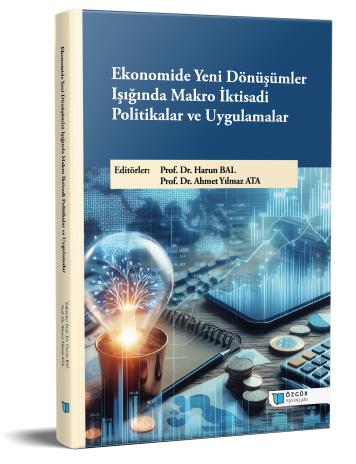
An Empirical Approach to Macroprudential Policies through Financial Stability and the International Investment Position (IIP): The Case of Turkey
Chapter from the book:
Bal,
H.
&
Ata,
A.
Y.
(eds.)
2025.
Macroeconomic Policies and Practices in Light of New Transformations in the Economy.
Synopsis
Macroprudential policies are a set of regulations aimed at protecting economic stability by reducing risks that may arise in the financial system. For developing economies such as Turkey, the focus of these policies is on limiting the rate of credit growth. The literature contains important findings regarding the long-term relationship between the international investment position (IIP) and financial stability in the context of macroprudential policies. In line with this, the study examines the effects of portfolio investments (assets and liabilities), which are sub-components of the IIP, on the credit-deposit ratio (total credit volume/deposits) in the Turkish economy. The analysis covers the period 2007Q4–2023Q2 and was conducted using the Toda-Yamamoto causality test and the Structural VAR method. The results show that there is no statistically significant relationship between asset-based portfolio investments and the credit-deposit ratio. In contrast, a causality relationship was found between liability-based portfolio investments and the credit-deposit ratio. Historical decomposition functions reveal that liability-based portfolio investments are the primary determinant of the credit-deposit ratio. This indicates that such investments increase the rate at which deposits are converted into loans, thereby amplifying financial fragility. However, in the context of the Turkish economy, this development creates a dual situation in terms of the sustainability of the current account deficit. This is because portfolio (liability) investments increase financial fragility but also make a positive contribution to financing the current account deficit. Therefore, a more selective approach to portfolio (especially liability) investments should be adopted in the policy-making process. Policy recommendations developed in this context include encouraging liability-based portfolio investments for the sustainability of the current account deficit; however, these resources should be directed towards productive investments and productive financial instruments rather than being evaluated only in short-term deposits. Furthermore, encouraging long-term investment behavior is also critical for strengthening financial stability in order to reduce systemic risks.
How to cite this book
License

This work is licensed under a Creative Commons Attribution-NonCommercial 4.0 International License.
Published
DOI
Categories
Copyright (c) 2025 Harun Bal- Ahmet Yılmaz Ata; Doğan Barak- Halim Tatlı- Fatih Akın- Ayşe Eryer- Rüya Ataklı Yavuz- Refika Görkem Yılmaztürk- Selen Savaşkan- İlknur Aşkın- Harun Bal- Koray Yıldırım- Esma Erdoğan- Süleyman Gürbüz- Nur Aydın- Ayşe Arı- Mehmet Ozan Akman- Bahadır Aybakan- Devran Deniz- Mustafa Orhan Özer- Gökhan Özkul- Özgenur Çakır Uysal- Tahsin Avcı- Emre Kılıç- Eren Ergen