
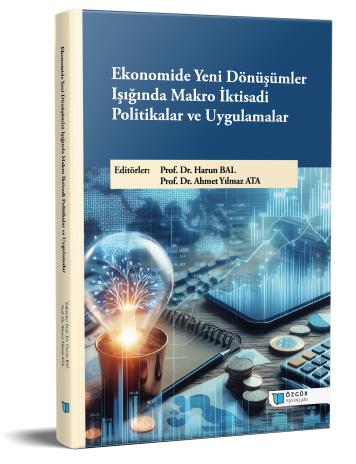
The Effect of Renewable Energy on Exchange Rate: The Case of Turkey
Chapter from the book:
Bal,
H.
&
Ata,
A.
Y.
(eds.)
2025.
Macroeconomic Policies and Practices in Light of New Transformations in the Economy.
Synopsis
This study examines whether renewable energy consumption mitigates the effects of exchange rate shocks. In this context, the impact of renewable energy consumption on real effective exchange rate volatility and nominal exchange rate volatility in Turkey is investigated. The AARDL (Augmented ARDL) method is applied in the study, and the time period 1990-2021 is analysed. According to the results obtained, renewable energy consumption has a negative effect on real effective exchange rate and nominal exchange rate volatility in the long term. Based on this evidence, it can be concluded that an increase in renewable energy consumption may reduce exchange rate volatility. Therefore, authorities' encouragement of renewable energy consumption will contribute to exchange rate stability. Beside, the analyses revealed that while international reserves have a negative effect on exchange rate volatility, inflation has a positive effect. In summary, to mitigate exchange rate fluctuations, policies aimed at increasing reserves, promoting renewable energy consumption, and achieving low inflation rates should be implemented.
How to cite this book
License

This work is licensed under a Creative Commons Attribution-NonCommercial 4.0 International License.
Published
DOI
Categories
Copyright (c) 2025 Harun Bal- Ahmet Yılmaz Ata; Doğan Barak- Halim Tatlı- Fatih Akın- Ayşe Eryer- Rüya Ataklı Yavuz- Refika Görkem Yılmaztürk- Selen Savaşkan- İlknur Aşkın- Harun Bal- Koray Yıldırım- Esma Erdoğan- Süleyman Gürbüz- Nur Aydın- Ayşe Arı- Mehmet Ozan Akman- Bahadır Aybakan- Devran Deniz- Mustafa Orhan Özer- Gökhan Özkul- Özgenur Çakır Uysal- Tahsin Avcı- Emre Kılıç- Eren Ergen