
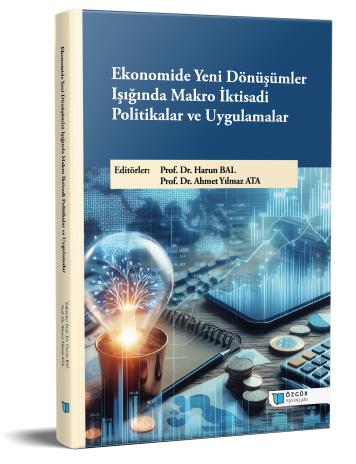
External Debt and Exchange Rate Nexus in Turkey: Short- and Long-Run Evidence
Chapter from the book:
Bal,
H.
&
Ata,
A.
Y.
(eds.)
2025.
Macroeconomic Policies and Practices in Light of New Transformations in the Economy.
Synopsis
For emerging economies, external borrowing represents a crucial source of development finance; however, it simultaneously poses substantial risks to macroeconomic stability. In this context, the present study aims to examine the long-run and short-run relationships between external debt stock and the exchange rate in the Turkish economy by employing annual data for the period 1990–2023. The Autoregressive Distributed Lag (ARDL) bounds testing approach is utilized to assess the existence of a cointegration relationship among the variables. In the empirical model, the nominal exchange rate is specified as the dependent variable, while the external debt stock expressed as a ratio to gross domestic product, the inflation rate, and the policy interest rate are incorporated as explanatory variables. The results of the ARDL bounds test provide strong evidence of a long-run cointegration relationship among the variables. Long-run estimation results indicate that increases in the external debt stock exert a positive and statistically significant effect on the nominal exchange rate. Moreover, inflation is found to have a positive and significant impact on the exchange rate, whereas the policy interest rate exhibits a negative and statistically significant effect. The findings derived from the error correction model (ECM) suggest that approximately 65% of any short-run disequilibrium is corrected in the subsequent period, implying a relatively rapid adjustment process toward the long-run equilibrium. Overall, the results underscore that effective external debt management and the composition of external borrowing are critical for maintaining exchange rate stability in Türkiye, and that monetary policy plays a significant role in shaping these macroeconomic dynamics.
How to cite this book
License

This work is licensed under a Creative Commons Attribution-NonCommercial 4.0 International License.
Published
DOI
Categories
Copyright (c) 2025 Harun Bal- Ahmet Yılmaz Ata; Doğan Barak- Halim Tatlı- Fatih Akın- Ayşe Eryer- Rüya Ataklı Yavuz- Refika Görkem Yılmaztürk- Selen Savaşkan- İlknur Aşkın- Harun Bal- Koray Yıldırım- Esma Erdoğan- Süleyman Gürbüz- Nur Aydın- Ayşe Arı- Mehmet Ozan Akman- Bahadır Aybakan- Devran Deniz- Mustafa Orhan Özer- Gökhan Özkul- Özgenur Çakır Uysal- Tahsin Avcı- Emre Kılıç- Eren Ergen