
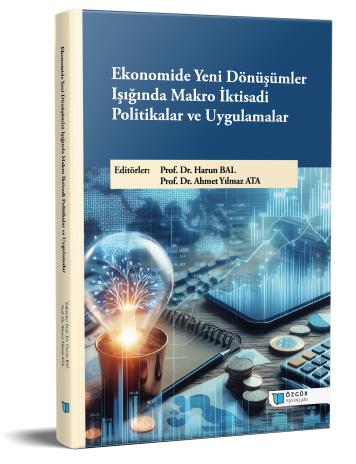
The Emergence, Spillover, and Economic Implications of Volatility in Financial Markets
Chapter from the book:
Bal,
H.
&
Ata,
A.
Y.
(eds.)
2025.
Macroeconomic Policies and Practices in Light of New Transformations in the Economy.
Synopsis
The acceleration of the globalization process and the deepening integration between financial markets have significantly increased the sensitivity of price movements in national markets to global dynamics. With this transformation, financial volatility has ceased to be merely technical data expressing the standard deviation in asset prices; it has become a multidimensional and dynamic phenomenon that shapes investor behavior, capital costs, and global risk appetite. In fact, today, volatility has gained the quality of an independent asset class that can be traded through derivative products, rather than just being a risk measure. The aim of this study is to examine the causes of volatility formation in financial markets, its types, cross-market spillover mechanisms, and its macroeconomic consequences on the real economy from a holistic perspective. Within the scope of the study, the theoretical foundations of volatility are discussed; historical, implied, and intraday realized volatility measurement methods and their reflections in securities and foreign exchange markets are detailed. The evaluations made show that volatility is affected by factors such as macroeconomic shocks, policy uncertainties, and information flow; and in times of crisis, it spreads rapidly between markets through financial contagion channels. It has been determined that increasing market correlations, especially in times of uncertainty, weaken portfolio diversification advantages and trigger a "flight to safety" tendency among investors. Furthermore, it has been concluded that high volatility causes the postponement of investment decisions in the real sector, tightens credit conditions, and suppresses economic activity. Consequently, the accurate modeling of volatility and its spillover effects carries strategic importance for both investors to develop effective portfolio and risk management strategies and for policymakers to take measures that support financial stability.
How to cite this book
License

This work is licensed under a Creative Commons Attribution-NonCommercial 4.0 International License.
Published
DOI
Categories
Copyright (c) 2025 Harun Bal- Ahmet Yılmaz Ata; Doğan Barak- Halim Tatlı- Fatih Akın- Ayşe Eryer- Rüya Ataklı Yavuz- Refika Görkem Yılmaztürk- Selen Savaşkan- İlknur Aşkın- Harun Bal- Koray Yıldırım- Esma Erdoğan- Süleyman Gürbüz- Nur Aydın- Ayşe Arı- Mehmet Ozan Akman- Bahadır Aybakan- Devran Deniz- Mustafa Orhan Özer- Gökhan Özkul- Özgenur Çakır Uysal- Tahsin Avcı- Emre Kılıç- Eren Ergen