
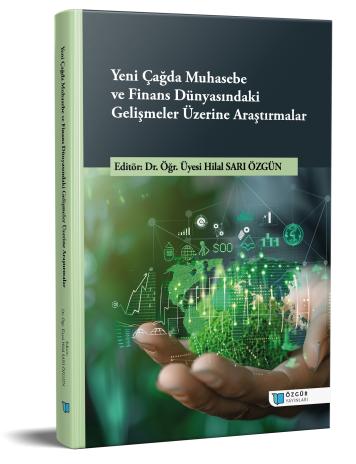
Risk Management and Fraud Auditing With a Forensic Accounting Approach: A Case Study
Chapter from the book:
Sarı Özgün,
H.
(ed.)
2025.
Research on Developments in The World of Accountıng and Fınance in The Modern Era .
Synopsis
The purpose of this study is to emphasize the active role of the accounting profession in combating fraudulent methods that misrepresent financial realities in businesses, thereby highlighting the need for the profession to become institutionalized in Turkey in order to combat fraud, which has an impact on crises around the world. Classical auditing, based on recorded data, is insufficient in identifying and measuring risks.
In digital auditing, a new era has begun in identifying and assessing risks through the quantification of risks, statistical models, data mining, developed software, probability calculations, etc. Digitalization has had different impacts across all areas of auditing, including tax, accounting, finance, internal control models, independent auditing, and other audit models. This difference provides faster, more comprehensive, efficient, and continuous auditing capabilities in risk assessment and fraud detection compared to classical auditing.
These developments have initiated a transformation in the profession, establishing a stronger role in managing uncertainties and introducing a new model as a risk manager. With the rapid development of comprehensive audit approaches and regulations aimed at analyzing all taxpayer behaviors in tax accounting, the accounting profession is now defined by new terms such as risk manager, financial protection specialist, financial analyst, and financial engineer. This change necessitates competence in identifying, preventing, and correcting risks in the face of continuous and real-time audit activities, the acquisition of digital skills, and therefore a proactive approach in the profession.
This study examines the implications of digitalization for auditing from a tax accounting perspective, while emphasizing the necessity of including forensic accounting in Turkey's legal framework. In this sense, a case study method was used in the application example where the practical application of the theory resolved in accounting law is included in understanding the accuracy of the financial data reflected in the company's financial statements. Examples of concealing true information and providing misleading information to parties are presented.
How to cite this book
License

This work is licensed under a Creative Commons Attribution-NonCommercial 4.0 International License.
Published
DOI
Categories
Copyright (c) 2025 Hilal Sarı Özgün; İsmail Atabay- Funda Karakoyun- Fatma Çıtak- İlker Sakınç- S. Öznur Sakınç- Sema Bacak- Saime Doğan- Aslı Keskin- Aysel Güney