
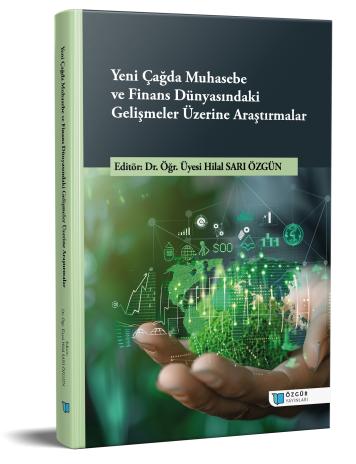
The Use of Machine Learning Methods in the Finance Literature and Their Application Areas
Chapter from the book:
Sarı Özgün,
H.
(ed.)
2025.
Research on Developments in The World of Accountıng and Fınance in The Modern Era .
Synopsis
This study explores how machine learning is used as a methodological tool in academic finance research. It examines how these methods are applied across four main areas of financial analysis. As digitalization, computing power, and artificial intelligence technologies continue to evolve, financial activities have shifted. What was once primarily driven by human judgment has increasingly become shaped by data and algorithms. This shift has positioned algorithms as either independent decision-makers or as tools that assist humans in financial decision-making.
The first area looks at how machine learning models handle complex, nonlinear relationships and large, high-dimensional datasets—especially when forecasting returns, volatility, and financial risk. The evidence shows that, in some situations, these models outperform traditional linear approaches. They offer better results in out-of-sample predictions and can hold more economic relevance.
The second area focuses on how natural language processing (NLP) and text mining help assess market expectations, investor sentiment, and uncertainty. These methods analyze financial news, reports, and digital content. The ability to process large volumes of unstructured data quickly allows these insights to be incorporated into forecasting models.
In the third area, the study explores machine learning in portfolio optimization, risk balancing, and algorithmic trading. It puts a spotlight on systems that connect prediction with real-time decisions. Here, factors like transaction costs, portfolio rebalancing limits, and adapting decision rules over time are particularly important.
The fourth area involves the use of machine learning for detecting anomalies, analyzing fraud, and studying market microstructure. The research shows that spotting unusual patterns or hidden relationships early on plays a key role in managing financial risk and supporting market integrity.
In sum, the study presents machine learning not as a one-size-fits-all solution but as a flexible, data-driven framework for tackling complex financial challenges.
How to cite this book
License

This work is licensed under a Creative Commons Attribution-NonCommercial 4.0 International License.
Published
DOI
Categories
Copyright (c) 2025 Hilal Sarı Özgün; İsmail Atabay- Funda Karakoyun- Fatma Çıtak- İlker Sakınç- S. Öznur Sakınç- Sema Bacak- Saime Doğan- Aslı Keskin- Aysel Güney