
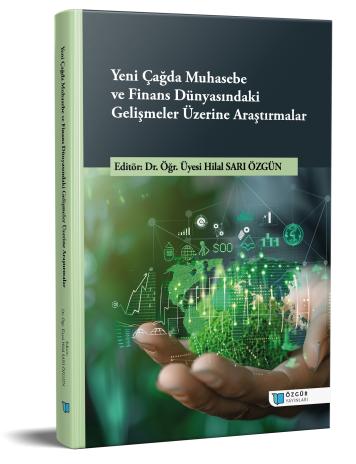
Sustainable Finance and Accounting Approaches: The Impact of ESG Criteria on Financial Decisions
Chapter from the book:
Sarı Özgün,
H.
(ed.)
2025.
Research on Developments in The World of Accountıng and Fınance in The Modern Era .
Synopsis
In today's changing and evolving economic system, traditional financial decision-making strategies are proving inadequate. Traditional financial decision-making processes focus on economic indicators while neglecting or failing to adequately address environmental and social risks. In this context, ESG criteria have become important components of financial management. These criteria are expressed as environmental (E), social (S) and governance (G). Today, ESG criteria are not merely ethical or environmental preferences; they are an approach that systematically integrates sustainable accounting practices into companies' financial statements, aims to create long-term value, meets investor demands, and enables corporate sustainability. Thus, ESG criteria form the cornerstone of the financial system in line with sustainable development goals.
The study covers the development process of sustainable finance, companies' sustainability-focused strategic decisions on financial performance, the internationally recognised GRI (Global Reporting Initiative) and SASB (Sustainability Accounting Standards Board) standards, and, specifically for Turkey, the TSRS (Turkey Sustainability Reporting Standards). These regulations enable businesses to report their ESG performance in a comparable, accountable and transparent manner. In summary, it strengthens the alignment of the national financial system with global sustainability standards. Furthermore, ESG criteria serve as an important benchmark in capital costs, investment preferences, corporate risk management, and financial reporting processes. Thus, ESG criteria have become an indispensable element for companies in terms of providing competitive advantage, long-term goals, and investor confidence.
How to cite this book
License

This work is licensed under a Creative Commons Attribution-NonCommercial 4.0 International License.
Published
DOI
Categories
Copyright (c) 2025 Hilal Sarı Özgün; İsmail Atabay- Funda Karakoyun- Fatma Çıtak- İlker Sakınç- S. Öznur Sakınç- Sema Bacak- Saime Doğan- Aslı Keskin- Aysel Güney