
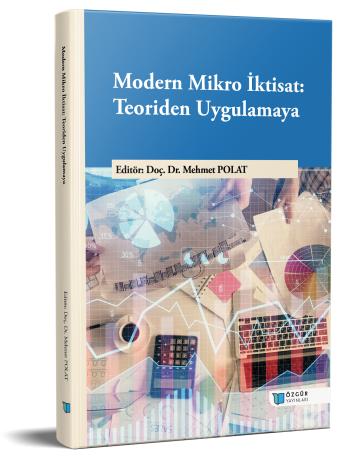
The Relationship Between Ecological Footprint and Human Development: An Empirical Analysis for Türkiye
Chapter from the book:
Polat,
M.
(ed.)
2025.
Modern Microeconomics: From Theory to Practice.
Synopsis
Sustainable development goals aim to go beyond economic growth and achieve improvements in quality of life within ecological limits. In this context, the development of social welfare is considered a complementary indicator of natural resources and environmental sustainability, and today it is among the priority research areas in both academic literature and policy-making processes. As in many studies in this context, this study uses the Human Development Index (HDI) published by the United Nations Development Program (UNDP) as an indicator of social welfare and improvements in living standards, and the Ecological Footprint (EF) as an indicator of the pressure of human activities on the environment. This study examines the relationship between the ecological footprint and the human development index for the sample of Turkey for the period 1990-2023. The results of the ARDL test show that there is an inverse U-shaped relationship between the ecological footprint and the human development index.
How to cite this book
License

This work is licensed under a Creative Commons Attribution-NonCommercial 4.0 International License.
Published
DOI
Categories
Copyright (c) 2025 Mehmet Polat; Semra Koçak- Mehmet Polat- Cemal Öztürk- Muhammed Genç- Hatime Kamilçelebi- Dilek Alma Savaş- Muhammed İkbal Tepeler- Murat Özdemir- Özcan Özkan- Mustafa Özer- Demet Topal Koç