
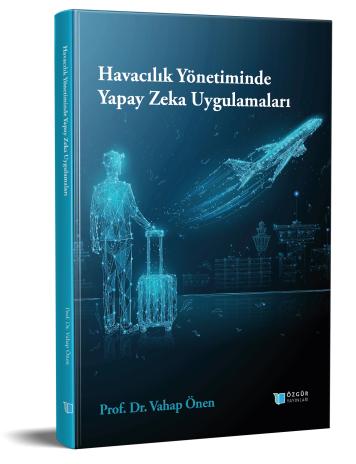
The Implementation Process of Artificial Intelligence in Air Traffic Management
Chapter from the book:
Önen,
V.
(ed.)
2025.
Artificial Intelligence Applications in Aviation Management.
Synopsis
This book chapter examines the scope of AI-based transformation in air traffic management (ATM) from a holistic perspective. It begins by explaining the fundamental components, operational processes, and system architecture of ATM, and then addresses the paradigm shift created by the integration of AI into the system. The evolving role of AI applications is evaluated in the context of automation levels, decision support systems, human-machine interaction, cognitive load, and safety management. The impacts of methods such as machine learning, deep learning, natural language processing, computer vision, predictive analytics, and multi-factor reinforcement learning on traffic flow, capacity planning, operational efficiency, and environmental sustainability are discussed. At the heart of the chapter are the DIALOG, ORCI, AWARE, SynthAIR, JARVIS, DARWIN, ASTRA, and TRUSTY projects conducted under the SESAR (Single European Sky ATM Research) program. The technical innovations, operational outputs, and human factors significance of these projects are analyzed. The study demonstrates how these projects are driving ATM transformation in areas such as digital assistants, hotspot prediction, complexity management, safety estimation, explainable artificial intelligence (XAI), and human-centered design. The discussion and conclusion section addresses critical elements such as reliability, ethical governance, workforce cohesion, skills loss, and cyberresilience, and offers policy and research recommendations to strengthen human-AI collaboration in the future.
How to cite this book
License

This work is licensed under a Creative Commons Attribution-NonCommercial 4.0 International License.
Published
DOI
Categories
Copyright (c) 2025 Vahap Önen; Mustafa Altıntaş- Seda Çeken- Teoman Erdağ- Elvan Karaarslan Göyenç- Tevfik Uyar- Ali Akbaba- Nil Konyalılar- Selvi Vural- Vahap Önen- Ayşe Küçük Yılmaz- Büşra Karakuş