
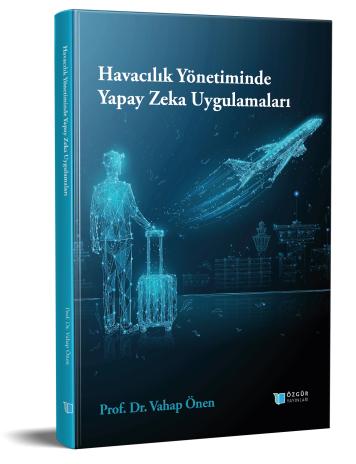
The Use of Artifical Intelligent in Air Traffic Control
Chapter from the book:
Önen,
V.
(ed.)
2025.
Artificial Intelligence Applications in Aviation Management.
Synopsis
Air traffic control is a fundamental element of the modern aviation industry in terms of safety, efficiency and coordination. Traditional methods are limited by human-reliant decision making processes and can sometimes prove inadequate in the face of increased congestion and complex airspace operations. Today, technological advancements, especially the innovations brought by artificial intelligence (AI), have begun to revolutionize air traffic management. AI through big data analytics and algorithms, provides critical advantages such as optimizing traffic flow, increasing flight safety, and reducing operational costs. In this context, AI-supported systems are integrated into real time decision-making processes and used in a wide range of areas, from flight planning and airspace management to the regulation of landing and take off times.
Furthermore, thanks to these Technologies,air traffic control centers can provide more proactive and precise management conditions and other enviromental factors. With the widespread use of artificial intelligence,systems are moving beyond human dependence, making preictions with high accuracy and increasing the level of automation. These developments play a critical role in both increasing safety and reducing traffic congestion.Therefore, artifical intelligence applications in air traffic control stand out as one of the fundamental building blocks of a sustainable and safer sector in modern aviation.
How to cite this book
License

This work is licensed under a Creative Commons Attribution-NonCommercial 4.0 International License.
Published
DOI
Categories
Copyright (c) 2025 Vahap Önen; Mustafa Altıntaş- Seda Çeken- Teoman Erdağ- Elvan Karaarslan Göyenç- Tevfik Uyar- Ali Akbaba- Nil Konyalılar- Selvi Vural- Vahap Önen- Ayşe Küçük Yılmaz- Büşra Karakuş